Today we will discuss about The 12 jyotirlinga name and place list (PPT and PDF Download) and 12 Jyotirlingas: Sacred Abodes of Lord Shiva with .pptx and .pdf so lets start the Journey Through India’s Most Revered Shiva Temples, In Hindu belief, Lord Shiva represents one of the most important deities in the pantheon. According to Hindu philosophy, there are three main gods known as the Trimurti or Trinity: Brahma the Creator, Vishnu the Preserver, and Shiva the Destroyer and Regenerator. This trinity works in cosmic harmony-Brahma creates the universe, Vishnu preserves and maintains it, and Shiva holds responsibility for destruction and regeneration.
According to Hindu texts, Shiva’s power of destruction serves a constructive purpose. His role involves removing imperfections and evil from the world, making way for renewal and rebirth. Hindu tradition describes Shiva as possessing ultimate power and achieving the supreme meditative state. While he can be wrathful and fierce, he is also quickly moved by devotion and love. According to belief, his consort Parvati brings balance to his fierce nature, representing the perfect equilibrium of masculine and feminine energies.
Hindu tradition speaks of various events and stories detailed in the Puranas and ancient texts. Shaivism represents one of the major sects of Hinduism, with Lord Shiva as the primary deity. While tradition mentions 64 Jyotirlingas across India, 12 are considered the most important and are venerated as supremely holy pilgrimage sites.
Note: This comprehensive guide draws from Hindu religious texts including Shiva Purana, Skanda Purana, historical records, and documented traditions. Temple locations and access information reflect current data. Legends represent traditional Hindu beliefs preserved in religious literature and oral tradition.
Understanding Jyotirlinga: The Radiant Sign of Shiva
Before examining each sacred site, understanding the concept of Jyotirlinga and the Shiva Linga itself provides essential context.
What is a Jyotirlinga?
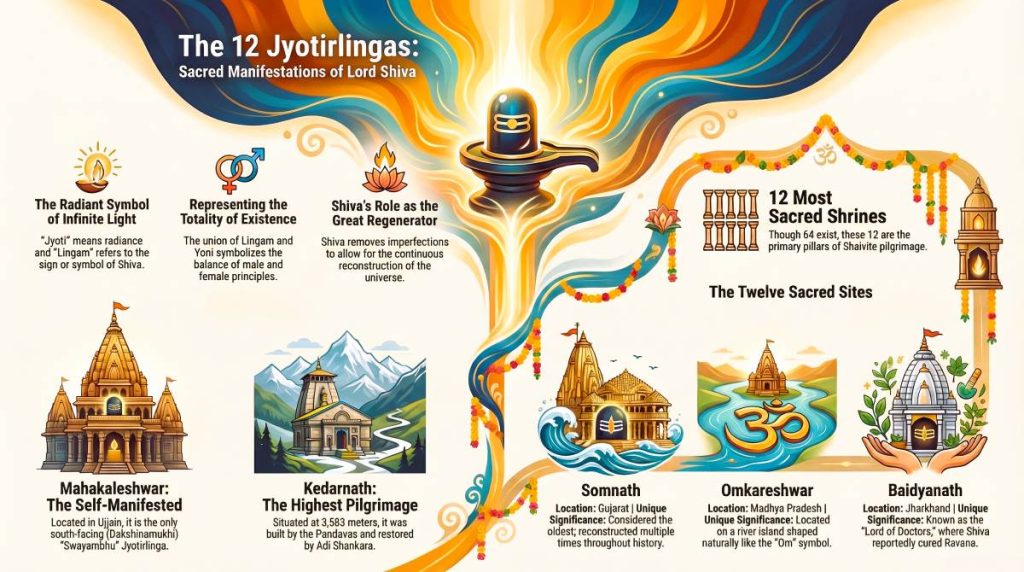
Jyotirlinga literally means ‘radiant sign’ or ‘pillar of light’ representing Lord Shiva. The term combines ‘Jyoti’ (light or radiance) with ‘Linga’ (sign or symbol). According to Hindu belief, at these twelve sacred locations, Lord Shiva manifested as a column of infinite light, establishing his supreme presence. These are not merely temples but places where the formless, eternal Shiva revealed himself in tangible form.
Understanding the Shiva Linga:
In Sanskrit, ‘Linga’ means distinguishing symbol. The Shiva Linga represents Lord Shiva’s cosmic energy and creative power. Hindu tradition views the Linga as an emblem of generative power and cosmic creation. The Linga typically appears as a cylindrical stone structure, adorned by devotees with flowers, water, milk, and bilva leaves during worship.
The Linga generally rests upon a Yoni, a circular base representing divine feminine energy. Together, they symbolize the union of male and female principles-the fundamental duality that creates existence. According to texts like Mahabharata and Puranas, the Linga represents Shiva’s celestial form. Hindus view the union of Linga and Yoni as symbolizing male and female principles coming together, representing the totality of existence and the creative force from which the universe springs.
Since Hindu philosophy considers Shiva as formless (Nirakara) and without attributes (Nirguna), direct representation becomes impossible. The Linga therefore serves as an abstract symbol enabling devotees to focus their devotion on the infinite, eternal reality that Shiva represents.
12 Jyotirlinga name and place list (PPT Download) | .PPTX
The 12 jyotirlinga name and place list: Complete Guide
#1. Somnath Jyotirlinga: The Eternal Shrine (Gujarat)
The Somnath temple stands as the first and oldest among the twelve Jyotirlingas, located in Prabhas Patan near Veraval in Gujarat’s Saurashtra region.
Location Details:
- State: Gujarat
- District: Gir Somnath
- City: Somnath (Prabhas Patan)
- Nearest airport: Diu (63 km) or Rajkot (200 km)
- Nearest railway: Veraval (5 km)
- Location: Western coast of India, Arabian Sea
Legend and Significance: According to legend, Soma the Moon God himself constructed this temple. The name ‘Somnath’ literally means ‘Lord of the Moon.’ The Moon God built this shrine to worship Shiva and seek relief from a curse. The temple stands at a unique location where no landmass exists between the shrine and Antarctica-a straight line from Somnath leads directly to the South Pole.
Historical Turbulence: Somnath connects deeply with Indian history, particularly during the Delhi Sultanate period. Historical records document that Mahmud of Ghazni, a ruler from the Delhi Sultanate era, attacked this temple approximately 16 times in the 11th century. He destroyed the Shiva Linga and looted the temple’s immense wealth. However, Hindu devotees reconstructed the temple multiple times, demonstrating extraordinary faith and resilience.
Current Status: The present structure was rebuilt in the Chalukya style of architecture and consecrated in 1951 after India’s independence. Today, Somnath remains one of Gujarat’s most important pilgrimage sites, attracting millions of devotees annually. The temple stands as a testament to Hindu resilience and faith, having been destroyed and rebuilt multiple times throughout history.
Also read: Top 30 Largest Empires in History by Land Area (.pptx)
#2. Mallikarjuna Jyotirlinga: The Divine Abode (Andhra Pradesh)
The Sri Mallikarjuna temple is located in Srisailam, Andhra Pradesh, holding unique importance as one of the few temples featuring both a Jyotirlinga and a Shakti Peetha (sacred site of Divine Feminine).
Location Details:
- State: Andhra Pradesh
- District: Kurnool
- City: Srisailam
- Nearest airport: Hyderabad (214 km)
- Situated: Nallamala Hills, Krishna River banks
Legend: According to Hindu belief, Shiva and Parvati resided at Srisailam to remain near their son Kartikeya. Kartikeya had taken a vow to live alone on Mount Kailash, but his parents stayed nearby at Srisailam to be close to him. The temple name combines ‘Mallika’ (jasmine) and ‘Arjuna’ (white), representing purity and devotion.
Special Significance: This Jyotirlinga is one of the 275 Paadal Petra Sthalams-divine places celebrated in devotional poetry spread across Asia. The temple architecture reflects Dravidian style with intricate carvings and gopurams. The serene location on Nallamala Hills creates a spiritually charged atmosphere perfect for meditation and worship.
#3. Mahakaleshwar Jyotirlinga: Lord of Time (Madhya Pradesh)
The Mahakaleshwar temple in Ujjain, Madhya Pradesh, represents one of the most revered Jyotirlingas and houses the only south-facing (Dakshinamurti) Jyotirlinga among the twelve.
Location Details:
- State: Madhya Pradesh
- City: Ujjain
- Located on: Banks of Shipra River
- Nearest airport: Indore (55 km)
- Railway: Ujjain Junction
Unique Characteristics: The Linga at Mahakaleshwar faces south (Dakshinamurti), unlike most Shiva Lingas that face east. Among all twelve Jyotirlingas, only Mahakaleshwar is considered Swayambhu (self-manifested), meaning the Linga emerged spontaneously rather than being installed. According to belief, Mahakal derives power from within itself, without any external consecration or establishment.
The Name’s Meaning: Mahakal connects not with death but with time itself. The name signifies ‘Great Time’ or ‘Lord of Time,’ representing Shiva as Ananta (eternal, infinite). Hindu philosophy describes Mahakal as transcending linear time, existing beyond the cycles of creation and destruction.
Bhasma Aarti and Festivals: The temple is famous for its unique Bhasma Aarti (worship using sacred ash) performed early every morning at 4 AM. During Maha Shivaratri, the temple witnesses massive congregations of devotees who worship throughout the night. Devotees perform elaborate rituals at all Jyotirlinga temples during this festival, but Mahakaleshwar’s celebrations are particularly grand.
#4. Omkareshwar Jyotirlinga: Lord of Om (Madhya Pradesh)
Omkareshwar, the second Jyotirlinga in Madhya Pradesh, sits on Mandhata Island in the Narmada River. The island’s unique shape resembles the sacred syllable ‘Om,’ giving the temple its name.
Location Details:
- State: Madhya Pradesh
- District: Khandwa
- Located on: Mandhata Island, Narmada River
- Nearest airport: Indore (77 km)
Two Sacred Temples: The site features two temples: Omkareshwar (Lord of Om) and Amareshwar (Immortal Lord). Both temples are considered part of the same Jyotirlinga manifestation. The island’s Om-shaped geography creates a spiritually charged atmosphere, with the Narmada’s sacred waters surrounding the site. Pilgrims can reach the island by bridge or ferry, adding to the pilgrimage experience.
#5. Kedarnath Jyotirlinga: The Himalayan Shrine (Uttarakhand)
Kedarnath represents the most challenging pilgrimage among the twelve Jyotirlingas, located at extreme altitude in the Himalayas of Uttarakhand. This temple endured a devastating natural disaster in 2013 but miraculously survived largely intact.
Location Details:
- State: Uttarakhand
- District: Rudraprayag
- Altitude: 3,583 meters (11,755 feet) above sea level
- Trek: 16 km from Gaurikund
- Accessible: April/May to November (6 months due to snow)
The 2013 Disaster: In June 2013, devastating floods caused by cloudbursts killed approximately 6,000 people in Uttarakhand. Ecologist Chandra Prakash Kala documented that the disaster caused estimated damages of $2.5 billion to roads and bridges, $30 million to dam projects, and $195 million losses to state tourism. Remarkably, while surrounding areas were devastated, the Kedarnath temple itself survived largely intact-a survival that devotees considered miraculous and strengthened their faith.
Legend and Access: According to tradition, the Pandavas (heroes of the Mahabharata) built this temple, and Adi Shankaracharya renovated it in the 8th century CE. The temple remains accessible only six months per year due to extreme winter conditions-heavy snow makes access impossible from November to April. This Jyotirlinga is also counted among the 275 Paadal Petra Sthalams and represents one of Hinduism’s most important pilgrimage destinations despite its challenging accessibility.
#6. Bhimashankar Jyotirlinga: Source of the Bhima River (Maharashtra)
Located in Maharashtra’s Sahyadri hills near Pune, Bhimashankar marks the source of the Bhima River. This temple showcases Nagara architectural style and holds significance in both religious and geographical contexts.
Location Details:
- State: Maharashtra
- District: Pune
- Located: Sahyadri Hills, near Khed Taluka
- Nearest city: Pune (approximately 100 km)
- Significance: Source of Bhima River
Architecture and Legend: The temple was constructed in the 18th century and displays Nagara architectural style. According to legend, the original temple was built for a self-manifested (Swayambhu) Shiva Linga. The location in the Western Ghats creates a scenic and spiritually serene environment. The origin of the Bhima River from this sacred site adds geographical significance to its religious importance.
#7. Kashi Vishwanath Jyotirlinga: Lord of the Universe (Uttar Pradesh)
The Kashi Vishwanath temple in Varanasi, Uttar Pradesh, ranks among the most sacred sites in Hinduism. Located on the banks of the holy Ganges River, it attracts millions of pilgrims annually.
Location Details:
- State: Uttar Pradesh
- City: Varanasi (Kashi, Banaras)
- Located: Banks of Ganges River
- Airport: Lal Bahadur Shastri International Airport, Varanasi
- Railway: Varanasi Junction
Significance: The temple is called Vishwanath, meaning ‘Lord of the Universe,’ because Shiva is believed to rule the entire cosmos from this sacred location. According to Hindu belief, Shiva not only rules the universe but also possesses the power to destroy and regenerate it. The temple holds special importance as it stands in Kashi, considered one of the oldest continuously inhabited cities in the world.
Holiest Status: Among all twelve Jyotirlingas, Kashi Vishwanath is considered the most sacred. Devotees believe that dying in Kashi ensures liberation (moksha) from the cycle of rebirth. The temple’s location on the Ganges adds to its spiritual significance, as the river itself is considered sacred in Hinduism.
#8. Trimbakeshwar Jyotirlinga: Trinity of Gods (Maharashtra)
Located near Nashik, Maharashtra, Trimbakeshwar represents a unique Jyotirlinga as it symbolizes all three gods of the Trinity: Brahma, Vishnu, and Shiva together.
Location Details:
- State: Maharashtra
- District: Nashik
- Located: Brahmagiri Mountain foothills
- Significance: Source of Godavari River
- Nearest city: Nashik (28 km)
Unique Trinity Symbolism: According to Shiva Purana, the Godavari River and sage Gautam requested Lord Shiva to reside at Trimbak. Shiva decided to dwell at Trimbakeshwar, making it unique among Jyotirlingas. The temple symbolizes the trinity through three faces representing Brahma (creator), Vishnu (preserver), and Shiva (destroyer), all unified in one manifestation. The location at the source of the Godavari River, one of India’s major sacred rivers, adds geographical and spiritual significance.
#9. Vaidyanath Jyotirlinga: Lord of Physicians (Jharkhand)
Located in Deoghar, Jharkhand, this Jyotirlinga earned its name when Lord Shiva healed demon king Ravana, demonstrating his compassion even toward those who opposed him.
Location Details:
- State: Jharkhand
- City: Deoghar
- District: Deoghar district
- Nearest railway: Jasidih Junction (7 km)
Legend of the Name: According to legend, Ravana performed intense penance and devotion to Shiva. Pleased with his devotion, Lord Shiva healed Ravana’s ailments. Since ‘Vaidya’ means physician or healer in Hindi/Sanskrit, the Jyotirlinga became known as Vaidyanath-‘Lord of Physicians.’ This story demonstrates Shiva’s quality of being moved by genuine devotion regardless of the devotee’s character, emphasizing that sincere faith transcends moral boundaries.
#10. Nageshwar Jyotirlinga: Lord of Serpents (Gujarat)
The second Jyotirlinga in Gujarat, Nageshwar is located near Dwarka. The name connects to serpents (Naga), representing Shiva’s association with serpent symbolism in Hindu iconography.
Location Details:
- State: Gujarat
- Location: Near Dwarka
- Historical location: Darukavana forest (according to Shiva Purana)
- Nearest city: Dwarka (approximately 17 km)
Krishna Connection: According to tradition, Lord Krishna performed Rudra Abhishek (ritual worship of Shiva as Rudra) at this location. This creates an interesting connection between two major Hindu deities. The Shiva Purana mentions that this Jyotirlinga is situated in the Darukavana forest, though the exact historical location has been debated by scholars. The temple’s proximity to Dwarka-Krishna’s legendary kingdom-makes it significant for both Shaivites and Vaishnavites.
#11. Rameshwaram Jyotirlinga: Lord Rama’s Shrine (Tamil Nadu)
Located on Rameshwaram Island in Tamil Nadu, this temple connects directly to the epic Ramayana. It represents the southernmost Jyotirlinga and holds special significance in Hindu pilgrimage tradition.
Location Details:
- State: Tamil Nadu
- Location: Rameshwaram Island
- District: Ramanathapuram
- Connected: Pamban Bridge to mainland
- Nearest airport: Madurai (163 km)
Ramayana Connection: According to Hindu tradition and the Ramayana, Lord Rama worshipped Shiva at this location before his battle with Ravana (who was a Brahmin and Shiva devotee despite being a demon king). Rama established a Shiva Linga and performed worship, seeking Shiva’s blessings for victory. This Linga became known as Ramanathaswamy (Lord of Rama) or Rameshwaram. The temple is also called Ramanath Swami temple. This legend creates a unique connection between Rama (Vishnu’s avatar) and Shiva, emphasizing the unity of different Hindu traditions.
#12. Grishneshwar Jyotirlinga: Lord of Compassion (Maharashtra)
The final and smallest Jyotirlinga is located near the famous Ellora Caves in Maharashtra, close to Aurangabad. This completes the sacred circuit of twelve Jyotirlingas.
Location Details:
- State: Maharashtra
- District: Aurangabad
- Located: Near Ellora Caves (UNESCO World Heritage Site)
- Distance from Aurangabad: Approximately 30 km
- Also known as: Ghushmeshwar
Smallest Yet Significant: Though it’s the smallest among the twelve Jyotirlingas in terms of temple size, Grishneshwar holds equal spiritual significance. The name means ‘Lord of Compassion,’ emphasizing Shiva’s merciful nature. Its proximity to the magnificent Ellora Caves-featuring remarkable rock-cut architecture from Buddhist, Hindu, and Jain traditions-makes it part of an important cultural and religious complex. Pilgrims often combine visits to both Ellora and Grishneshwar.
The Cosmic Cycle: Shiva’s Role in Creation and Destruction
According to Hindu belief, the universe regenerates approximately every 2.16 billion years (calculated differently in various texts). This cycle of creation and destruction represents fundamental Hindu cosmology. Shiva’s role as destroyer is crucial to this cosmic process-after destruction, Shiva hands over responsibility to Brahma who recreates the universe anew.
Hindu texts present Shiva with thousands of definitions and multiple forms. He is simultaneously described as detached from intelligence and worldly affairs, yet also wrathful. According to beliefs, Shiva is considered the leader of spirits, ghosts, and other supernatural beings. As the supreme yogi and primary deity of Shaivism, he serves as protector of sacred Hindu texts and Vedas. Because Shiva is described as formless (Nirakara) and without attributes (Nirguna), worship focuses on the Linga as his symbolic representation rather than anthropomorphic images.
Beyond the Stone: The Cosmic Secrets of India’s 12 Sacred Pillars of Light
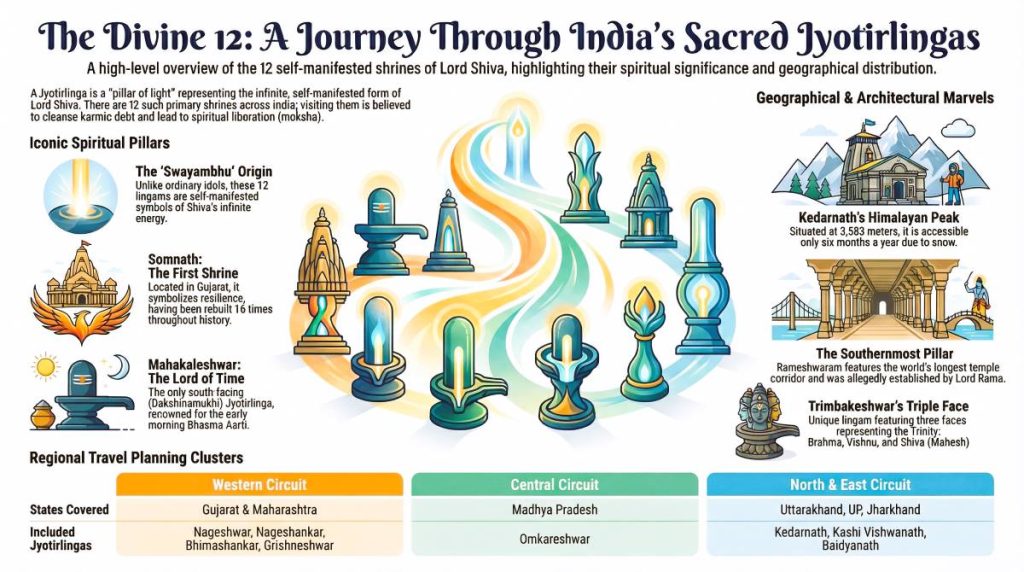
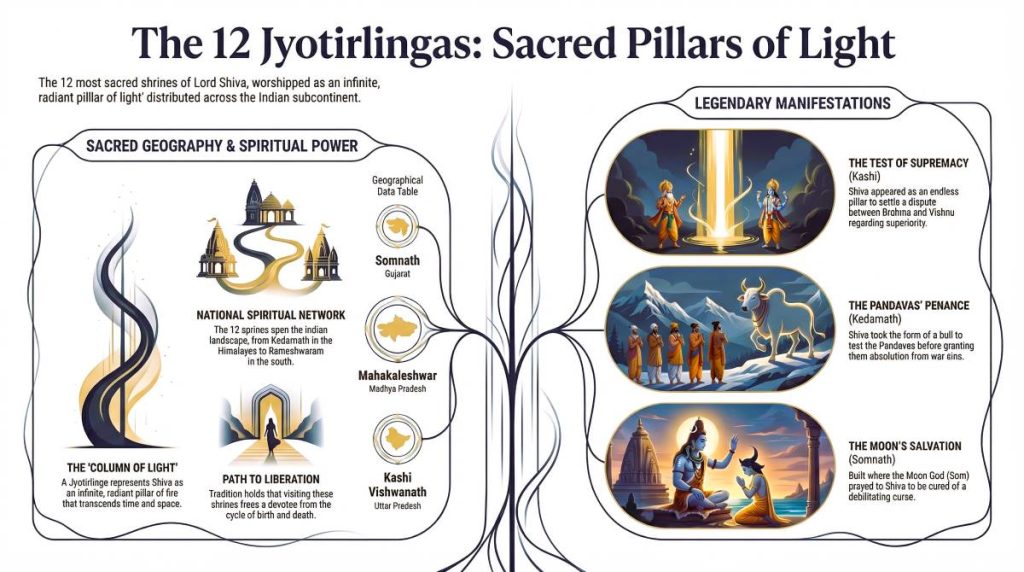
In Vedic tradition, a Jyotirlinga isn’t just a temple-it’s a terrestrial manifestation of infinite, boundless energy. The term combines Jyoti (radiance) and Linga (symbol), representing locations where Lord Shiva appeared as a Stambha-a cosmic, infinite pillar of light that pierced the three worlds, possessing neither beginning nor end.
The legend begins with a celestial contest between Lord Brahma and Lord Vishnu over supremacy. To settle their debate, Shiva manifested as this boundless column of energy, demonstrating that the divine is not a stagnant idol but dynamic, living power.
Scattered from the glacial Himalayan peaks to tropical southern shores, these twelve shrines form a unified energy field across the Indian subcontinent. But beyond the devotion, these sites hold surprising secrets: a temple rebuilt 16 times, a deity facing the direction of death, an island naturally shaped like “Om,” and a cosmic map linking each shrine to a zodiac sign.
For the modern seeker, these aren’t just religious monuments-they’re a spiritual cartography bridging ancient Vedic wisdom with a contemporary search for meaning.
The 7 Most Surprising Revelations
1. The Architecture of Resilience: Rebuilt 16 Times
Somnath Temple (Gujarat), perched where Arabian Sea spray meets Chalukya-style stone, holds the distinction of being the first Jyotirlinga on Earth. But its true revelation lies in defiance: Somnath has been destroyed and reconstructed sixteen times across centuries of invasions.
This resilience mirrors its legend-the Moon God Chandra performed penance here to regain his luster after a curse. Just as the moon waxes and wanes, Somnath repeatedly returns from ashes, symbolizing the cyclical nature of time and indestructible faith. Lesson: Rejuvenation is always possible when the core remains consecrated.
2. The “Lord of Death” Faces South
Mahakaleshwar Temple (Ujjain, Madhya Pradesh) challenges traditional Vastu norms. While most Hindu shrines face East toward the rising sun, Mahakaleshwar is Dakshinamukhi-the only Jyotirlinga facing South, the direction of Yama (god of death).
Shiva sits as Mahakal (“Lord of Time and Death”), intentionally facing the direction humans fear most. The temple was famously established by a five-year-old boy named Srikar, whose pure devotion moved the divine to manifest.
Spiritual significance: By facing South, Shiva transforms our fear of mortality into a quest for moksha (liberation). To stand before Mahakal is to confront time’s inevitability and find peace knowing the soul remains untouched.
3. Geography as Sacred Geometry: The Island Shaped Like “Om”
At Omkareshwar (Khandwa, Madhya Pradesh), the Earth itself becomes a divine scribe. The Narmada River carves Mandhata island into the natural shape of “ॐ” (Om)-not man-made, but a geographical phenomenon.
Unique feature: Pilgrims must visit both Omkareshwar and Amaleshwar (Mamleshwar) shrines to complete their journey, representing the non-duality of the divine. The island literally embodies the Vedic concept that the universe is composed of sound energy.
4. The Triple-Faced Enigma: Where the Trinity Becomes One
Trimbakeshwar Temple (Maharashtra), cradled in the Sahyadri mountains at the Godavari River’s source, presents a unique iconographic mystery. Unlike singular pillars, this lingam features three distinct faces representing Brahma (Creator), Vishnu (Preserver), and Mahesh/Shiva (Destroyer).
Profound lesson: The central lingam is slowly eroding from continuous ritual bathing (abhisheka). This physical wearing away serves as a metaphor for impermanence-just as the stone dissolves, the seeker’s ego must also be washed away for spiritual rebirth.
5. A Celestial Map: 12 Shrines Linked to 12 Zodiac Signs
Vedic astrology suggests the 12 Jyotirlingas aren’t randomly placed-they’re connected to the 12 Zodiac signs (Rashis), creating a personalized spiritual roadmap where each shrine resonates with specific birth energies and balances karmic traits.
Surprising details:
- At Mallikarjuna, devotees can actually touch the deity (rare privilege)
- At Kedarnath (12,000 feet in the Himalayas), aarti mantras are recited in Kannada-testament to India’s cultural crossover
6. The Divine Healer: Shiva as Cosmic Doctor
Baidyanath Temple (Jharkhand) reveals Shiva as the Vaidya (Divine Healer). Legend tells how when demon king Ravana offered his ten heads as sacrifice, Shiva appeared not to destroy him but to act as a cosmic doctor, reattaching and healing the heads.
This healing theme drives the incredible Shrawan Mela, where millions of Kanwariyas travel barefoot over vast distances carrying holy water to the shrine. This extreme physical penance is a psychological journey of shedding ego-pushing the body to its limits to heal the spirit.
7. The Eternal Pilgrimage: From Geography to Consciousness
Though scattered across India, these twelve sites form a singular, unified energy field. They’re “radiant pillars” reminding us of divine omnipresence, yet diverse enough to meet seekers wherever they are-whether seeking courage, healing, or strength to face mortality.
The truth: The real destination of the Jyotirlinga yatra isn’t a map coordinate, but a shift in consciousness. The “pillar of light” exists within you.
Complete Jyotirlinga Overview: 12 jyotirlinga name and place in Hindi
| No. | Jyotirlinga Name | Location (State) | Unique Characteristic | Spiritual Significance |
|---|---|---|---|---|
| 1 | Somnath (सोमनाथ) | Veraval, Gujarat | Rebuilt 16 times; Arabian Sea coastline | Resilience, rejuvenation, cycles of time |
| 2 | Mallikarjuna (मल्लिकार्जुन) | Srisailam, Andhra Pradesh | Devotees can touch the deity | Stability, love, prosperity (Venus energy) |
| 3 | Mahakaleshwar (महाकालेश्वर) | Ujjain, Madhya Pradesh | Only south-facing Jyotirlinga (Dakshinamukhi) | Conquering fear of death; time mastery |
| 4 | Omkareshwar (ओंकारेश्वर) | Khandwa, Madhya Pradesh | Island naturally shaped like “Om” (ॐ) | Universal sound vibration; non-duality |
| 5 | Kedarnath (केदारनाथ) | Rudraprayag, Uttarakhand | 12,000 ft altitude; aarti in Kannada language | Leadership, devotion, spiritual elevation |
| 6 | Bhimashankar (भीमाशंकर) | Pune, Maharashtra | Source of Bhima River; dense forest setting | Service nature, analytical clarity |
| 7 | Baidyanath (बैद्यनाथ) | Deoghar, Jharkhand | Shiva as Divine Healer (Vaidya); Shrawan Mela | Healing of body and spirit |
| 8 | Trimbakeshwar (त्र्यंबकेश्वर) | Nashik, Maharashtra | Three-faced lingam (Brahma-Vishnu-Shiva); eroding stone | Impermanence, ego dissolution |
| 9 | Kashi Vishwanath (काशी विश्वनाथ) | Varanasi, Uttar Pradesh | Most famous; city of liberation | Moksha, spiritual freedom, ultimate wisdom |
| 10 | Nageshwar (नागेश्वर) | Dwarka, Gujarat | Protects from snake venom (mythology) | Discipline, resilience, protection |
| 11 | Rameshwaram (रामेश्वरम) | Ramanathapuram, Tamil Nadu | Bridge to Sri Lanka; Ramayana connection | Detachment, creativity, forgiveness |
| 12 | Grishneshwar (घृष्णेश्वर मन्दिर) | Aurangabad, Maharashtra | Last Jyotirlinga mentioned in Shiva Purana | Intuition, compassion, spiritual culmination |
Zodiac Connections: Your Personalized Spiritual Roadmap
| Zodiac Sign (Rashi) | Ruling Planet | Corresponding Jyotirlinga | Location | Spiritual Energy & Blessing |
|---|---|---|---|---|
| Aries (Mesh) | Mars | Somnath | Gujarat | Builds courage and leadership; warrior energy |
| Taurus (Vrishabh) | Venus | Mallikarjuna | Andhra Pradesh | Promotes stability, love, and prosperity |
| Gemini (Mithun) | Mercury | Mahakaleshwar | Madhya Pradesh | Enhances intellect and communication skills |
| Cancer (Karka) | Moon | Omkareshwar | Madhya Pradesh | Brings emotional calm and spiritual depth |
| Leo (Simha) | Sun | Kedarnath | Uttarakhand | Empowers leadership, devotion, and vitality |
| Virgo (Kanya) | Mercury | Bhimashankar | Maharashtra | Sharpens analysis and service nature |
| Libra (Tula) | Venus | Baidyanath | Jharkhand | Enhances balance, health, and relationships |
| Scorpio (Vrishchik) | Mars/Ketu | Trimbakeshwar | Maharashtra | Aids transformation, healing, and rebirth |
| Sagittarius (Dhanu) | Jupiter | Kashi Vishwanath | Uttar Pradesh | Supports wisdom and spiritual freedom |
| Capricorn (Makar) | Saturn | Nageshwar | Gujarat | Strengthens discipline, resilience, protection |
| Aquarius (Kumbh) | Saturn/Rahu | Rameshwaram | Tamil Nadu | Invokes creativity, detachment, innovation |
| Pisces (Meen) | Jupiter/Ketu | Grishneshwar | Maharashtra | Enhances intuition, compassion, spiritual depth |
Geographical & Architectural Distinctions -12 jyotirlinga name and place list
| Jyotirlinga | Elevation/Setting | Architectural Style | Natural Feature | Access Difficulty |
|---|---|---|---|---|
| Somnath | Sea level (Arabian Sea coast) | Chalukya style | Coastal waves, salt spray | Easy |
| Mallikarjuna | Hill fort (Srisailam) | Dravidian architecture | Krishna River gorge | Moderate |
| Mahakaleshwar | Ujjain city | North Indian temple style | Ancient Shipra River | Easy |
| Omkareshwar | River island | Medieval architecture | Narmada River “Om” shape | Moderate |
| Kedarnath | 12,000 ft Himalayas | Stone temple | Glacial peaks, Mandakini River | Difficult (seasonal) |
| Bhimashankar | Sahyadri mountains | Maharashtra temple style | Dense forest, Bhima River source | Moderate |
| Baidyanath | Plains (Deoghar) | Temple complex | Holy water pilgrimage route | Easy |
| Trimbakeshwar | Sahyadri foothills | Hemadpanthi architecture | Godavari River source | Moderate |
| Kashi Vishwanath | Ganges riverbank | Gold-spired temple | Sacred Ganges ghats | Easy |
| Nageshwar | Coastal Gujarat | Modern reconstruction | Near Dwarka (Krishna’s city) | Easy |
| Rameshwaram | Island (Gulf of Mannar) | Dravidian corridors | Bridge to Sri Lanka | Moderate |
| Grishneshwar | Near Ellora Caves | Medieval stone temple | Artistic cave complex nearby | Easy |
Legendary Origins & Mythological Context
| Jyotirlinga | Origin Legend | Associated Deity/Devotee | Key Miracle/Event |
|---|---|---|---|
| Somnath | Moon God (Chandra) performed penance for curse removal | Chandra (Moon) | Regained lost luster through devotion |
| Mallikarjuna | Shiva-Parvati reconciliation after sons’ contest | Shiva-Parvati divine couple | Family reunion and blessings |
| Mahakaleshwar | Established by 5-year-old boy Srikar | Young devotee Srikar | Pure child’s devotion manifested Shiva |
| Omkareshwar | King Mandhata’s penance; island creation | King Mandhata | River carved “Om” shape naturally |
| Kedarnath | Pandavas sought Shiva’s forgiveness after Mahabharata war | Pandavas (Mahabharata) | Shiva appeared as bull; temple at hump |
| Bhimashankar | Demon Bhima defeated by Shiva | Demon Bhima | Victory over evil; protection granted |
| Baidyanath | Shiva as cosmic doctor reattached Ravana’s 10 heads | Ravana (demon king) | Healing power demonstrated |
| Trimbakeshwar | Sage Gautama’s cow-slaughter atonement | Sage Gautama | Godavari River’s sacred origin |
| Kashi Vishwanath | Eternal city; Shiva’s favorite abode | All seekers of moksha | Liberation from cycle of rebirth |
| Nageshwar | Protection from snake demon | Devotee Supriya | Shiva as protector from venom/evil |
| Rameshwaram | Lord Rama worshipped Shiva before Lanka battle | Lord Rama | Bridge to Sri Lanka; Ramayana connection |
| Grishneshwar | Ghushma’s devotion despite family tragedy | Devotee Ghushma | Resurrection of dead son; ultimate faith |
Unique Rituals & Pilgrim Experiences
| Jyotirlinga | Special Ritual/Practice | Best Time to Visit | Unique Pilgrim Experience |
|---|---|---|---|
| Somnath | Evening aarti facing Arabian Sea | October-March | Waves crashing during prayers |
| Mallikarjuna | Touching the deity (rare permission) | Maha Shivaratri | Direct physical contact with lingam |
| Mahakaleshwar | Bhasma Aarti (ash ritual) at dawn | February-March | South-facing meditation on mortality |
| Omkareshwar | Visiting both Omkareshwar & Amaleshwar | October-March | Circumambulating “Om”-shaped island |
| Kedarnath | Pandavas’ footsteps pilgrimage trail | May-October (closed in winter) | Arduous Himalayan trek |
| Bhimashankar | Forest trek to river source | October-February | Wildlife, nature immersion |
| Baidyanath | Shrawan Mela barefoot water pilgrimage | July-August (monsoon) | Millions walk vast distances |
| Trimbakeshwar | Witnessing eroding three-faced lingam | August-February | Meditation on impermanence |
| Kashi Vishwanath | Ganges bathing + temple darshan | Year-round (avoid summer heat) | Liberation city; death = moksha |
| Nageshwar | Snake protection prayers | October-March | Near Krishna’s Dwarka city |
| Rameshwaram | 22 holy wells ritual bathing | October-April | Ram Setu (bridge) pilgrimage |
| Grishneshwar | Combined with Ellora Caves visit | October-March | Art + spirituality fusion |
Spiritual Lessons from Each Shrine – 12 jyotirlinga name and place list Table
| Jyotirlinga | Core Spiritual Lesson | Psychological Teaching | Modern Relevance |
|---|---|---|---|
| Somnath | Resilience through destruction | Phoenix rising from ashes | Recovery from failure/trauma |
| Mallikarjuna | Stability and devoted love | Healthy relationships require presence | Work-life balance |
| Mahakaleshwar | Facing mortality without fear | Death is natural; soul is eternal | Anxiety management |
| Omkareshwar | Universal sound as creation | Everything is vibration/energy | Quantum physics parallel |
| Kedarnath | Devotion requires sacrifice | Spiritual elevation needs effort | Delayed gratification |
| Bhimashankar | Service to nature and others | Analytical clarity serves humanity | Environmental stewardship |
| Baidyanath | Healing begins with ego surrender | Physical penance heals spirit | Mind-body medicine |
| Trimbakeshwar | Impermanence and ego dissolution | Nothing material is permanent | Minimalism, detachment |
| Kashi Vishwanath | Liberation from rebirth cycle | Wisdom frees from suffering | Mindfulness, meditation |
| Nageshwar | Discipline creates protection | Consistent practice builds resilience | Habit formation |
| Rameshwaram | Forgiveness and detachment | Let go of past grievances | Conflict resolution |
| Grishneshwar | Compassion despite tragedy | Maintain faith through loss | Grief processing |
The Bottom Line: A Pilgrimage Within
The twelve Jyotirlingas form more than a religious circuit-they’re a unified energy field mapping both geography and consciousness across India. Each shrine offers a distinct facet of the infinite light:
Physical Lessons:
- Somnath: Resilience through 16 reconstructions
- Kedarnath: Endurance at 12,000 feet
- Baidyanath: Physical penance for spiritual healing
Directional Wisdom:
- Mahakaleshwar: Only south-facing shrine (facing death)
- All others: East-facing (toward rising sun/new beginnings)
Geographical Marvels:
- Omkareshwar: Island naturally shaped like “Om”
- Trimbakeshwar: Source of sacred Godavari River
- Rameshwaram: Bridge to Sri Lanka
Unique Iconography:
- Trimbakeshwar: Three-faced lingam (Trinity unity)
- All others: Single pillar representation
Astrological Connection:
- Each of 12 shrines corresponds to a zodiac sign
- Personalized spiritual roadmap based on birth chart
- Balances karmic traits through specific energy
The profound truth: The true destination isn’t a coordinate on a map, but a shift in consciousness. The “pillar of light” that Shiva manifested as an infinite column exists not just in these twelve physical locations-it exists within you.
In a world of constant motion, these ancient sites ask: Which facet of this eternal light do you need to illuminate your own path?
Whether you seek courage like Aries at Somnath, healing like Libra at Baidyanath, or the wisdom to face mortality like Gemini at Mahakaleshwar, the Jyotirlingas offer a timeless technology for inner transformation.
The pilgrimage begins not when you board a train to Ujjain or trek to Kedarnath-it begins when you recognize that the infinite pillar of light piercing the three worlds is the same divine spark residing in your own consciousness.
Conclusion: The Spiritual Journey of the Twelve Jyotirlingas
The twelve Jyotirlingas represent Lord Shiva’s infinite presence manifested across the Indian subcontinent, from Gujarat’s western coast to Tamil Nadu’s southern island, from the Himalayan heights of Kedarnath to the plains of Varanasi. These sacred sites span India’s diverse geography, climatic zones, and cultural regions, yet they unite in common purpose-providing devotees with tangible locations to connect with the formless divine.
Each Jyotirlinga carries unique legends, architectural styles, geographical significance, and spiritual importance:
- Somnath represents resilience, having been destroyed and rebuilt multiple times
- Mahakaleshwar embodies time itself as the only south-facing and self-manifested Jyotirlinga
- Kedarnath demonstrates faith’s power, surviving natural disasters while accessible only six months yearly
- Kashi Vishwanath stands as the holiest, promising liberation to those who die in its sacred precincts
- Rameshwaram connects Hindu epics, bridging Shaivism and Vaishnavism through Rama’s worship
Together, these twelve shrines form a sacred circuit that millions of Hindus aspire to complete in their lifetime. The pilgrimage represents not merely a physical journey but a spiritual quest toward understanding the divine, transcending ego, and experiencing the ultimate reality that Shiva symbolizes.
These temples have endured centuries of invasions, natural disasters, and social upheavals, yet they continue inspiring faith and devotion. They stand as testament to Hindu spiritual resilience, architectural brilliance, and the enduring power of religious belief. From the destruction and rebuilding of Somnath to Kedarnath’s survival of the 2013 floods, these Jyotirlingas embody the very principle Shiva represents-destruction followed by renewal, death followed by rebirth.
Maharashtra hosts the most Jyotirlingas (three: Bhimashankar, Trimbakeshwar, and Grishneshwar), while Madhya Pradesh has two (Mahakaleshwar and Omkareshwar), and Gujarat has two (Somnath and Nageshwar). The remaining six are distributed across Andhra Pradesh, Uttarakhand, Uttar Pradesh, Jharkhand, and Tamil Nadu, making the pilgrimage a true journey across India’s spiritual landscape.
Which story from the Shiva Purana or tales of Lord Shiva has most influenced your life? The twelve Jyotirlingas teach different lessons-resilience, compassion, the transcendence of time, the power of devotion, and the unity underlying apparent diversity. As pilgrims journey from temple to temple, they don’t merely visit locations but embark on an inner transformation, moving closer to understanding the eternal, formless reality that these radiant signs of Shiva represent.
About This Guide
This comprehensive guide draws from Hindu religious texts including Shiva Purana, Skanda Purana, Mahabharata, and other ancient scriptures. Location details reflect current access information. Historical events like the Somnath invasions and 2013 Kedarnath disaster are documented in historical records and contemporary reports. Legends represent traditional Hindu beliefs as preserved in religious literature and oral tradition. Temple architecture descriptions and geographical details are based on documented sources and pilgrim testimonies.
Readers planning pilgrimages should verify current access conditions, opening hours, and travel requirements with temple authorities and local tourism offices. Weather conditions, especially at high-altitude locations like Kedarnath, require careful consideration. The spiritual significance and legends reflect Hindu religious traditions and should be understood within their cultural and theological context.