Today we will discuss about the Top 30 Largest Empires in History by Land Area with PPT and Pdf and the Top 30 Largest, Biggest and Greatest Empires in History (World): A Journey Through the World’s Greatest Civilizations so, Throughout human history, ambitious rulers and powerful civilizations have risen to control vast territories, shaping the world as we know it today. From the windswept steppes of Mongolia to the sun-drenched shores of the Mediterranean, these empires left indelible marks on culture, politics, religion, and human civilization itself.
This comprehensive guide explores the 30 largest empires in world history, ranked by territorial extent at their peak. We’ll journey through millennia of conquest, governance, and cultural exchange to understand how these mighty civilizations rose, ruled, and ultimately fell.
Understanding Empire Size: How We Measure Historical Power
Before diving into our list, it’s essential to understand how historians measure empire size. The most common metric is land area at peak territorial extent, measured in square kilometers or square miles. However, other important factors include:
- Population controlled – Both absolute numbers and percentage of world population
- Duration of rule – How long the empire maintained its power
- Cultural influence – Lasting impacts on language, religion, and governance
- Economic might – Control of trade routes and resources
For this article, we’ll primarily rank by land area while highlighting these other significant factors.
Top 30 Largest Empires in History by Land Area (.pptx)
The 30 Largest Empires in History
#1. The British Empire (1583–1997)
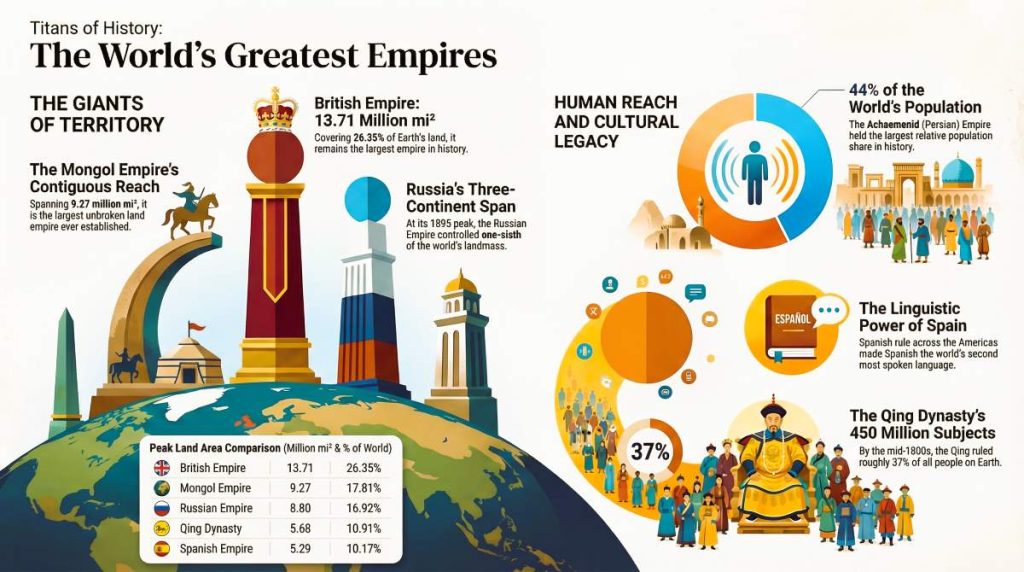
Peak Land Area: 35.5 million km² (13.71 million sq mi)
Peak Year: 1920
World Land Coverage: ~24% of Earth’s land surface
Population at Peak: ~458 million (23% of world population)
The British Empire stands as the largest empire in human history, earning its famous moniker: “the empire on which the sun never sets.” At its zenith following World War I, British territories spanned every inhabited continent.
Key Rulers:
- Queen Victoria (1837-1901) – Presided over the empire’s greatest expansion
- King George V (1910-1936) – Ruled during the empire’s territorial peak
- Queen Elizabeth II (1952-2022) – Witnessed its gradual dissolution
Major Territories:
- India (the “Crown Jewel”)
- Canada, Australia, New Zealand
- Large swaths of Africa (Egypt, Sudan, Kenya, South Africa, Nigeria)
- Caribbean islands
- Hong Kong and Singapore in Asia
- Parts of the Middle East
Lasting Legacy: The British Empire profoundly shaped the modern world. English became the global lingua franca, parliamentary democracy spread worldwide, and the Commonwealth of Nations continues today with 56 member states. However, the empire’s legacy is complex, marked by both developmental infrastructure and colonial exploitation.
Fascinating Facts:
- The Royal Navy’s dominance ensured British control of global trade routes
- English common law influenced legal systems in dozens of countries
- The British East India Company initially governed India, not the crown
- World War II bankrupted Britain, accelerating decolonization
#2. The Mongol Empire (1206–1368)
Peak Land Area: 24 million km² (9.27 million sq mi)
Peak Year: 1279
Distinction: Largest contiguous land empire in history
Population at Peak: ~110 million (25% of world population)
The Mongol Empire, forged by Genghis Khan and his successors, conquered more territory in 25 years than the Romans did in 400. This unprecedented expansion created the largest contiguous land empire ever known.
Key Rulers:
- Genghis Khan (1206-1227) – Founder and first Great Khan, united the Mongol tribes
- Ögedei Khan (1229-1241) – Genghis’s successor, expanded westward into Europe
- Kublai Khan (1260-1294) – Established the Yuan Dynasty in China
Major Territories: From the Pacific Ocean to Eastern Europe, the Mongol Empire included:
- All of China
- Korea
- Modern-day Mongolia and vast regions of Central Asia
- Persia (modern Iran and Iraq)
- Parts of Eastern Europe and Russia
- The Middle East
Lasting Legacy: Despite their fearsome military reputation, the Mongols facilitated unprecedented cultural exchange along the Silk Road. They promoted religious tolerance, established efficient communication systems (the Yam), and enabled trade between East and West. Marco Polo’s famous travels occurred during the Pax Mongolica.
Fascinating Facts:
- Genghis Khan’s cavalry could ride 80 miles per day
- The Mongols pioneered psychological warfare and meritocracy in military ranks
- They devastated so many cities that some scientists believe it temporarily reduced global carbon emissions
- Genetic studies suggest Genghis Khan has approximately 16 million male descendants today
#3. The Russian Empire (1721–1917)
Peak Land Area: 22.8 million km² (8.8 million sq mi)
Peak Year: 1895
World Land Coverage: ~15% of Earth’s land surface
Population at Peak: ~125 million people
Founded by Peter the Great, the Russian Empire was the third-largest empire in history and the second-largest contiguous land empire. It stretched across three continents and eleven time zones.
Key Rulers:
- Peter the Great (1682-1725) – Founded the empire, modernized Russia
- Catherine the Great (1762-1796) – Expanded Russia’s borders significantly
- Alexander II (1855-1881) – Abolished serfdom, expanded into Central Asia
- Nicholas II (1894-1917) – Last Tsar, overthrown in the Russian Revolution
Major Territories:
- All of modern Russia
- Alaska (sold to the US in 1867)
- Finland, Poland, and the Baltic states
- Parts of modern Ukraine, Belarus, and Moldova
- Central Asian territories (modern Kazakhstan, Uzbekistan, etc.)
- Parts of the Caucasus
Lasting Legacy: The Russian Empire’s expansion eastward opened Siberia and connected Europe to the Pacific. Russian culture, literature, and Orthodox Christianity spread across its vast domain. Today, Russia remains the world’s largest country by land area, retaining much of the empire’s former territory.
Fascinating Facts:
- The Trans-Siberian Railway, completed in 1916, connected Moscow to Vladivostok across 9,289 km
- Russia’s sale of Alaska to the US for $7.2 million is considered one of history’s biggest land deals
- The empire played a crucial role in defeating Napoleon in 1812
#4. The Qing Dynasty (1644–1912)
Peak Land Area: 14.7 million km² (5.68 million sq mi)
Peak Year: 1790
Population at Peak: ~381 million (36.6% of world population)
China’s last imperial dynasty, the Qing Dynasty, was established by the Manchu people and became one of the most populous empires in history. Despite being ethnically Manchu, they adopted Chinese governance systems and culture.
Key Rulers:
- Shunzhi Emperor (1644-1661) – First Qing emperor, captured Beijing
- Kangxi Emperor (1661-1722) – Longest-reigning emperor, consolidated power
- Qianlong Emperor (1735-1796) – Presided over the empire’s territorial and cultural peak
- Empress Dowager Cixi (1861-1908) – De facto ruler during late dynasty decline
Major Territories:
- All of modern China
- Mongolia
- Tibet
- Xinjiang
- Taiwan
- Parts of Central Asia
Lasting Legacy: The Qing Dynasty shaped modern China’s borders and integrated diverse ethnic groups into Chinese identity. It preserved and promoted Chinese culture while expanding territorially. However, conflicts with Western powers in the 19th century (Opium Wars) and the Taiping Rebellion weakened the dynasty, leading to its eventual collapse in 1912.
Fascinating Facts:
- The Qing military campaigns pacified rebellions and expanded borders to their greatest extent
- The Qianlong Emperor commissioned the Siku Quanshu, the largest collection of books in Chinese history
- The Forbidden City served as the dynasty’s imperial palace
- The Qing maintained a sophisticated bureaucratic system requiring civil service examinations
#5. The Spanish Empire (1492–1976)
Peak Land Area: 13.7 million km² (5.29 million sq mi)
Peak Year: 1790
Duration: ~500 years
Population at Peak: ~68 million people
The Spanish Empire was the first truly global empire, establishing colonies on every inhabited continent. It pioneered transoceanic colonization and trade, fundamentally altering world history.
Key Rulers:
- Isabella I & Ferdinand II (1474-1516) – Sponsored Columbus, united Spain
- Charles V (1516-1556) – Ruled Spain at its most powerful
- Philip II (1556-1598) – Oversaw peak territorial expansion
- Charles III (1759-1788) – Implemented Bourbon reforms
Major Territories:
- Most of Central and South America
- The Philippines
- Parts of North America (Florida, California, Texas, Southwest US)
- Caribbean islands
- Parts of Africa and the Pacific
Lasting Legacy: Spanish became the world’s second-most spoken native language. Spanish colonial architecture, Catholicism, and cultural practices spread across the Americas. The empire’s silver mines funded European development but devastated indigenous populations through disease and exploitation.
Fascinating Facts:
- The Spanish dollar became the world’s first global currency
- Spanish galleons transported silver from Potosí (modern Bolivia) across the Pacific to Manila, then to China
- The Spanish Inquisition lasted from 1478 to 1834
- Spanish explorers like Cortés and Pizarro conquered the Aztec and Inca empires with relatively small forces
#6. The Second French Colonial Empire (1830–1980)
Peak Land Area: 11.5 million km² (4.44 million sq mi)
Peak Year: 1920
World Land Coverage: ~8.6% of Earth’s land
Population at Peak: ~110 million people
France’s second colonial empire (distinct from its Napoleonic era) emerged in the 19th century and became the second-largest empire of the 20th century, rivaling Britain’s reach.
Key Leaders:
- Napoleon III (1852-1870) – Expanded French colonialism in Africa and Asia
- Jules Ferry (Prime Minister 1880s) – Champion of colonial expansion
- Charles de Gaulle (1944-1946, 1958-1969) – Oversaw decolonization
Major Territories:
- Large portions of West and Central Africa (French West Africa, French Equatorial Africa)
- Madagascar
- Indochina (Vietnam, Laos, Cambodia)
- Parts of the Caribbean and South America (French Guiana)
- Islands in the Pacific and Indian Oceans
- Territories in North Africa (Algeria, Morocco, Tunisia)
Lasting Legacy: French became an international language of diplomacy and culture. Today, French is an official language in 29 countries. The French legal code (Napoleonic Code) influenced law systems worldwide. However, France’s colonial wars, particularly in Algeria and Indochina, were brutal and controversial.
Fascinating Facts:
- France still maintains overseas territories (French Guiana, Réunion, New Caledonia) with full French citizenship
- The French Foreign Legion was established to defend colonial interests
- Paris became known as the “City of Light” partly due to colonial wealth
- French colonial architecture blends with local styles in former colonies
#7. The Abbasid Caliphate (750–1258)
Peak Land Area: 11.1 million km² (4.29 million sq mi)
Peak Year: 750-800
Population at Peak: ~50 million people
Significance: Islamic Golden Age
The Abbasid Caliphate, the third Islamic caliphate, overthrew the Umayyads and ushered in the Islamic Golden Age. Baghdad became the world’s intellectual and cultural center.
Key Rulers:
- Abu al-Abbas as-Saffah (750-754) – Founded the dynasty
- Al-Mansur (754-775) – Founded Baghdad as the capital
- Harun al-Rashid (786-809) – Most famous caliph, golden age peak
- Al-Ma’mun (813-833) – Promoted science and translation movement
Major Territories:
- Mesopotamia (modern Iraq)
- Persia (Iran)
- Central Asia
- Arabian Peninsula
- North Africa
- Parts of the Indian subcontinent
Lasting Legacy: The Abbasid period saw revolutionary advances in mathematics (algebra, algorithm), astronomy, medicine, chemistry, and philosophy. The House of Wisdom in Baghdad translated and preserved Greek, Roman, Persian, and Indian texts. This knowledge later sparked the European Renaissance.
Fascinating Facts:
- The modern number system (Arabic numerals) spread during this era
- Al-Khwarizmi’s work gave us “algebra” and “algorithm”
- The “One Thousand and One Nights” stories feature Harun al-Rashid
- Baghdad’s population may have reached 1 million, making it the world’s largest city
- The Mongols destroyed Baghdad in 1258, ending the caliphate
#8. The Umayyad Caliphate (661–750)
Peak Land Area: 11 million km² (4.25 million sq mi)
Peak Year: 720
Population at Peak: ~62 million (29% of world population)
Significance: Largest empire of its time
The Umayyad Caliphate was the second Islamic caliphate and, at its peak, one of history’s largest empires. It was the first to rule as a hereditary dynasty rather than through elected caliphs.
Key Rulers:
- Muawiyah I (661-680) – Founded the dynasty, established Damascus as capital
- Abd al-Malik (685-705) – Established Arabic as the official language
- Al-Walid I (705-715) – Oversaw greatest expansion
- Hisham ibn Abd al-Malik (724-743) – Ruled at territorial peak
Major Territories: Spanning three continents:
- North Africa from Egypt to Morocco
- Iberian Peninsula (Spain and Portugal)
- Arabian Peninsula
- Levant and Mesopotamia
- Persia and parts of Central Asia
- Parts of the Indian subcontinent
Lasting Legacy: The Umayyads spread Islam across North Africa and into Europe, profoundly shaping these regions’ futures. Islamic architecture flourished, including the Dome of the Rock in Jerusalem and the Great Mosque of Damascus. The dynasty established Arabic as the administrative language, promoting linguistic unity.
Fascinating Facts:
- The Umayyad invasion of Spain (711) began 800 years of Muslim presence in Iberia
- They created the first Islamic gold currency (dinar)
- The dynasty’s focus shifted the Islamic world’s center from Arabia to the Levant
- After the Abbasids overthrew them, one Umayyad prince escaped to Spain and established a separate emirate that lasted until 1031
#9. The Yuan Dynasty (1271–1368)
Peak Land Area: 11 million km² (4.25 million sq mi)
Peak Year: 1310
Population at Peak: ~75 million people
Significance: Mongolian rule of China
The Yuan Dynasty, established by Kublai Khan (Genghis Khan’s grandson), represented the Mongol conquest of China and marked the first time the entire country was ruled by foreign conquerors.
Key Rulers:
- Kublai Khan (1260-1294) – Founder and first emperor
- Temür Khan (1294-1307) – Grandson of Kublai, maintained stability
- Toghon Temür (1333-1368) – Last Yuan emperor, fled to Mongolia
Major Territories:
- All of China
- Mongolia
- Korea (as a vassal)
- Parts of Central Asia
- Tibet
Lasting Legacy: The Yuan Dynasty unified China after centuries of division, established Beijing as the imperial capital (where it remains today), and facilitated unprecedented East-West exchange. Marco Polo’s famous travels occurred during Kublai Khan’s reign.
Fascinating Facts:
- Kublai Khan attempted (and failed) to invade Japan twice; typhoons destroyed his fleets, giving rise to the “kamikaze” (divine wind) legend
- The dynasty introduced paper currency as primary money
- Chinese drama and novel literature flourished during this period
- The Grand Canal was extended to Beijing under Yuan rule
- After the dynasty’s fall, its remnants ruled as the Northern Yuan Dynasty in Mongolia until 1635
#10. The Portuguese Empire (1415–1999)
Peak Land Area: 10.4 million km² (4.02 million sq mi)
Peak Year: 1815
Duration: 584 years (longest-lived colonial empire)
Population at Peak: ~24.3 million
Portugal created the first global maritime empire, pioneering oceanic exploration and establishing the blueprint for European colonialism.
Key Figures:
- Prince Henry the Navigator (1394-1460) – Sponsored early exploration
- Vasco da Gama (1469-1524) – First to reach India by sea (1498)
- King João III (1521-1557) – Expanded to Asia and the Americas
- António de Oliveira Salazar (1932-1968) – Maintained colonies longest
Major Territories:
- Brazil (largest territory)
- Angola and Mozambique in Africa
- Goa, Daman, and Diu in India
- East Timor
- Macau (China)
- Various trading posts across Africa and Asia
Lasting Legacy: Portuguese became an official language in nine countries. Portugal’s maritime innovations (caravel ships, navigation techniques) enabled the Age of Discovery. However, the empire was built on slavery and exploitation, particularly in Brazil and Africa.
Fascinating Facts:
- Portugal was the first European power to establish trading posts in India, China, and Japan
- Macau was returned to China in 1999, ending nearly 600 years of empire
- The Treaty of Tordesillas (1494) divided the non-European world between Portugal and Spain
- Portuguese traders introduced tempura to Japan and chili peppers to India
#11. The Xiongnu Empire (209 BCE – 93 CE)
Peak Land Area: 9 million km² (3.47 million sq mi)
Peak Year: ~176 BCE
Significance: First major nomadic empire
The Xiongnu were a confederation of nomadic peoples who dominated the eastern Eurasian steppe and frequently raided China, eventually forcing the construction and expansion of the Great Wall.
Key Rulers:
- Modu Chanyu (209-174 BCE) – Founded the empire, united nomadic tribes
- Junchen Chanyu (174-160 BCE) – Expanded westward
- Zhizhi Chanyu (56-36 BCE) – Ruled during internal division
Major Territories: Centered on the Mongolian plateau:
- Mongolia
- Manchuria
- Parts of Siberia
- Central Asian territories
- Northern China border regions
Lasting Legacy: The Xiongnu established patterns of steppe nomad warfare and diplomacy that later empires (including the Mongols) would follow. Their conflicts with the Han Dynasty shaped early Chinese foreign policy and military strategy. Some historians believe the Xiongnu may have been related to or evolved into the Huns who later invaded Europe.
Fascinating Facts:
- The Han Dynasty initially paid tribute to the Xiongnu to maintain peace
- Xiongnu cavalry tactics influenced military development across Eurasia
- Their sophisticated social structure included hereditary nobility and merit-based positions
- Internal divisions and Han military campaigns eventually split the confederation in 48 CE
#12. The Rashidun Caliphate (632–661)
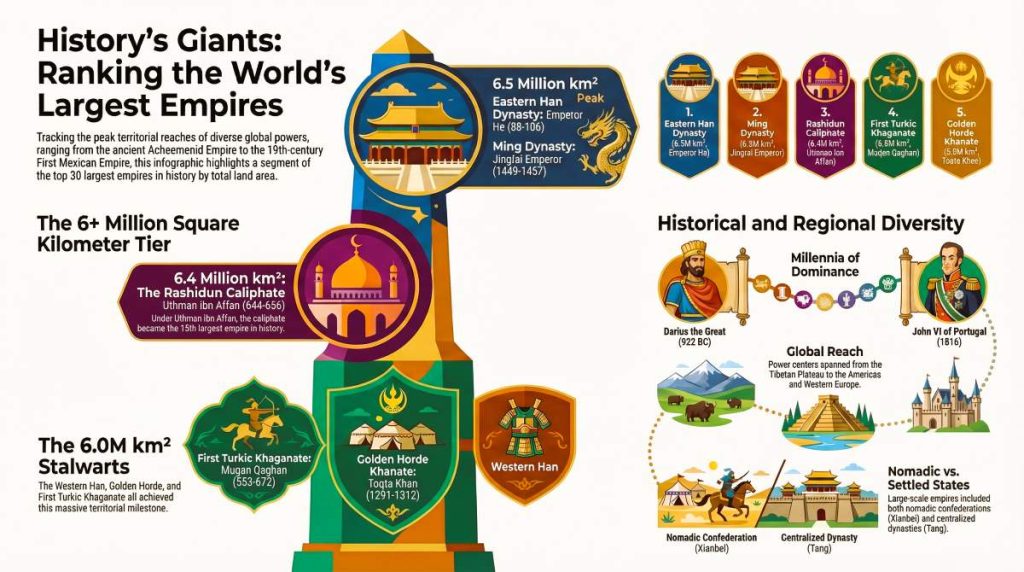
Peak Land Area: 9 million km² (3.47 million sq mi)
Peak Year: 654
Duration: 29 years
Significance: First Islamic caliphate, rapid expansion
The Rashidun Caliphate, led by Muhammad’s closest companions, achieved one of history’s most rapid territorial expansions, doubling in size in just three decades.
The Four Rashidun Caliphs:
- Abu Bakr (632-634) – First caliph, consolidated Arabian Peninsula
- Umar ibn al-Khattab (634-644) – Conquered Syria, Egypt, and Persia
- Uthman ibn Affan (644-656) – Expanded further, compiled Quran
- Ali ibn Abi Talib (656-661) – Fourth caliph, faced civil war (First Fitna)
Major Territories:
- Arabian Peninsula
- Levant (Syria, Palestine, Lebanon, Jordan)
- Egypt
- Mesopotamia (Iraq)
- Persia (Iran)
- Parts of North Africa
- Parts of Central Asia and the Caucasus
Lasting Legacy: The Rashidun established the template for Islamic governance and law. Their military campaigns spread Islam beyond Arabia permanently. The caliphate’s early administration, including land management and taxation systems, influenced subsequent Islamic empires.
Fascinating Facts:
- The Rashidun defeated two superpowers: the Byzantine and Sasanian Empires
- Caliph Umar established the Islamic calendar (Hijri calendar)
- The period is considered a “Golden Age” by many Muslims for its piety and justice
- The caliphate’s end marked the beginning of hereditary Islamic rule under the Umayyads
Also read: Top 10 Biggest and Largest Indian Empires (.PPTX & .PDF)
#13. The Empire of Brazil (1822–1889)
Peak Land Area: 8.5 million km² (3.28 million sq mi)
Peak Year: 1889
Duration: 67 years
Significance: Only monarchy in the Americas after independence
The Empire of Brazil was South America’s largest nation and the only country in the Americas to have a monarchy after gaining independence from European rule.
Key Rulers:
- Pedro I (1822-1831) – Declared independence, first emperor
- Pedro II (1831-1889) – Longest-reigning Brazilian monarch (58 years)
Territory: Virtually identical to modern Brazil’s borders, encompassing:
- Most of northern South America
- Amazon rainforest
- Brazilian highlands
- Extensive coastline along the Atlantic
Lasting Legacy: The Brazilian Empire gradually abolished slavery (fully by 1888, later than its neighbors), developed coffee and rubber industries, and maintained stability while Spanish American republics faced turmoil. It peacefully transitioned to a republic in 1889.
Fascinating Facts:
- Brazil was the only Portuguese colony to become an independent monarchy
- Pedro II was an intellectual emperor who promoted science, education, and the arts
- Brazil fought the Paraguayan War (1864-1870), the bloodiest conflict in South American history
- The empire’s end was partly due to the military’s discontent and republicanism
#14. The Empire of Japan (1868–1945)
Peak Land Area: 8.5 million km² (3.28 million sq mi)
Peak Year: 1942
Duration: 77 years
Population at Peak: ~134 million
Japan’s imperial expansion began with the Meiji Restoration and ended with World War II. It was the only Asian power to colonize other Asian territories during the modern era.
Key Rulers:
- Emperor Meiji (1867-1912) – Modernized Japan, began expansion
- Emperor Taishō (1912-1926) – Oversaw WWI territorial gains
- Emperor Hirohito (1926-1989) – Presided over expansion and wartime defeat
Major Territories:
- Japanese home islands
- Korea (annexed 1910)
- Taiwan (from 1895)
- Parts of China (Manchukuo puppet state)
- Pacific islands (from Germany after WWI)
- Parts of Southeast Asia during WWII (Philippines, Burma, Indochina, Indonesia)
Lasting Legacy: Japan’s rapid modernization demonstrated that an Asian nation could match Western powers. However, its colonial rule was marked by brutality, particularly in Korea and China. Post-war Japan renounced military expansion and became an economic powerhouse.
Fascinating Facts:
- Japan went from feudal isolation to imperial power in less than 50 years
- The empire’s expansion was driven by resource scarcity and population pressure
- Japanese became an official language in Korea and Taiwan during occupation
- The atomic bombings of Hiroshima and Nagasaki ended the empire’s military ambitions
#15. The Han Dynasty (206 BCE – 220 CE)
Peak Land Area: 6.5 million km² (2.51 million sq mi)
Peak Year: 100 CE
Population at Peak: ~57 million people
Duration: 426 years
Significance: Consolidated Chinese culture, opened Silk Road
The Han Dynasty, one of China’s most influential periods, established many aspects of Chinese culture that persist today. Its success was so profound that the majority ethnic group in China still calls itself “Han Chinese.”
Key Rulers:
- Emperor Gaozu (206-195 BCE) – Founded the dynasty
- Emperor Wu (141-87 BCE) – Expanded empire, opened Silk Road
- Emperor Guangwu (25-57 CE) – Restored Han after brief Wang Mang usurpation
- Emperor Xian (189-220 CE) – Last emperor, became puppet of warlords
Major Territories:
- All of eastern China
- Parts of Korea
- Northern Vietnam
- Xinjiang and Central Asia
- Parts of Mongolia
Lasting Legacy: The Han Dynasty stabilized China after the Qin Dynasty’s harsh rule, promoted Confucianism as state ideology, invented paper, developed porcelain, and opened the Silk Road for trade with the West. Their bureaucratic system, based on civil service examinations, lasted until 1912.
Fascinating Facts:
- The Silk Road connected China with Rome, enabling trade in silk, spices, and ideas
- Han scientists made the first seismograph to detect earthquakes
- The Han census was remarkably sophisticated for its time
- Buddhism entered China from India during the Han Dynasty
- The period produced great historians like Sima Qian, whose “Records of the Grand Historian” chronicled Chinese history
#16. The Sassanid Empire (224–651 CE)
Peak Land Area: 6.5 million km² (2.51 million sq mi)
Peak Year: 621 CE
Duration: 427 years
Significance: Last pre-Islamic Persian empire
The Sassanid Empire was the second Persian Empire and one of the most important powers of late antiquity, rivaling Rome and later Byzantium for control of the Middle East.
Key Rulers:
- Ardashir I (224-242) – Founded the empire, overthrew Parthians
- Shapur I (240-270) – Defeated Roman emperors, expanded empire
- Khosrow I “Anushirvan” (531-579) – Golden age, reformed administration
- Khosrow II (590-628) – Briefly conquered Byzantine territories
- Yazdegerd III (632-651) – Last shah, defeated by Muslim Arabs
Major Territories:
- All of modern Iran
- Iraq
- Armenia and parts of the Caucasus
- Parts of Central Asia
- Eastern Arabia
- Parts of modern Afghanistan, Pakistan
- Briefly controlled Egypt and parts of Anatolia
Lasting Legacy: The Sassanids promoted Zoroastrianism as the state religion and created a sophisticated artistic and architectural tradition. They established a powerful centralized bureaucracy and promoted learning. After the Islamic conquest, many Persian administrative practices were adopted by the caliphates.
Fascinating Facts:
- The empire engaged in centuries of conflict with Rome/Byzantium
- Sassanid chess influenced the modern game
- The Rock Reliefs at Naqsh-e Rostam depict Sassanid victories over Rome
- Shapur I captured Roman Emperor Valerian in 260 CE, a humiliating defeat for Rome
- The empire fell to Arab Muslim armies exhausted by decades of war with Byzantium
#17. The Ming Dynasty (1368–1644)
Peak Land Area: 6.5 million km² (2.51 million sq mi)
Peak Year: 1450
Population at Peak: ~160 million
Duration: 276 years
Significance: Restored Han Chinese rule, built most of Great Wall
The Ming Dynasty restored Han Chinese rule after Mongol domination, initiated the treasure voyages to Africa, and constructed most of today’s Great Wall of China.
Key Rulers:
- Hongwu Emperor (1368-1398) – Founded the dynasty, expelled Mongols
- Yongle Emperor (1402-1424) – Commissioned Forbidden City, sponsored Zheng He’s voyages
- Wanli Emperor (1572-1620) – Longest reign (48 years)
- Chongzhen Emperor (1627-1644) – Last emperor, committed suicide as rebels took Beijing
Major Territories:
- All of eastern China
- Manchuria (claimed)
- Yunnan
- Tibet (nominal control)
- Parts of Mongolia
Lasting Legacy: The Ming built or rebuilt much of the Great Wall as it exists today. The Forbidden City in Beijing was constructed during this period. Ming porcelain (“china”) became world-famous. The dynasty’s maritime expeditions under Admiral Zheng He reached Africa decades before European exploration began.
Fascinating Facts:
- Zheng He’s treasure ships were among history’s largest wooden vessels, dwarfing Columbus’s ships
- The Forbidden City took 14 years and over 1 million workers to complete
- Ming rulers moved the capital from Nanjing to Beijing
- The dynasty faced constant threats from Japanese pirates (wokou) and Mongol raids
- Internal corruption, natural disasters, and peasant rebellions led to the dynasty’s collapse
#18. The Achaemenid Empire / First Persian Empire (550–330 BCE)
Peak Land Area: 5.5 million km² (2.12 million sq mi)
Peak Year: 500 BCE
Population at Peak: ~49 million (44% of world population)
Significance: First true intercontinental empire
The Achaemenid Empire, founded by Cyrus the Great, was the ancient world’s largest empire and the first to span three continents, setting the template for future empires.
Key Rulers:
- Cyrus the Great (550-530 BCE) – Founded the empire, conquered Babylon
- Cambyses II (530-522 BCE) – Conquered Egypt
- Darius I “The Great” (522-486 BCE) – Organized empire, built Persepolis
- Xerxes I (486-465 BCE) – Invaded Greece, defeated at Salamis
- Darius III (336-330 BCE) – Last emperor, defeated by Alexander the Great
Major Territories:
- Modern Iran (Persia)
- Mesopotamia (Iraq)
- Egypt
- Anatolia (Turkey)
- Parts of India (Indus Valley)
- Parts of Central Asia
- Thrace (European Turkey)
Lasting Legacy: The Achaemenids pioneered efficient imperial administration through satrapies (provinces), established the Royal Road communication system, and practiced religious tolerance. Cyrus the Great freed Jewish captives in Babylon, earning biblical praise. The empire’s art, architecture (Persepolis), and governance influenced all subsequent Middle Eastern empires.
Fascinating Facts:
- The empire controlled 44% of the world’s population, the highest percentage ever
- The Royal Road allowed messages to travel 2,700 km in just 7 days
- Darius I created one of the first international currencies (the daric)
- Cyrus the Great’s tomb at Pasargadae was respected even by Alexander the Great
- The Greco-Persian Wars inspired much of Western classical literature
#19. The Ottoman Empire (1299–1922)
Peak Land Area: 5.2 million km² (2.01 million sq mi)
Peak Year: 1683
Duration: 623 years
Population at Peak: ~39 million people
One of history’s longest-lasting empires, the Ottoman Empire controlled crucial territory connecting Europe, Asia, and Africa for over six centuries.
Key Rulers:
- Osman I (1299-1323) – Founder of the dynasty
- Mehmed II “The Conqueror” (1444-1446, 1451-1481) – Conquered Constantinople (1453)
- Suleiman the Magnificent (1520-1566) – Presided over the empire’s golden age
- Mehmed VI (1918-1922) – Last sultan, abolished after WWI
Major Territories:
- Modern Turkey (Anatolia)
- Balkans (Greece, Bulgaria, Serbia, Bosnia, Albania, parts of Romania and Hungary)
- Middle East (Syria, Iraq, Palestine, Arabia)
- North Africa (Egypt, Libya, Tunisia, Algeria)
- Parts of the Caucasus and Crimea
Lasting Legacy: The Ottoman Empire was remarkably multi-ethnic and multi-religious, governing with the millet system that gave autonomy to religious communities. Ottoman architecture (especially mosques designed by Mimar Sinan) influenced regional styles. Turkish coffee, Turkish baths, and Ottoman cuisine spread widely.
Fascinating Facts:
- Constantinople’s fall in 1453 marked the end of the Byzantine Empire and the Middle Ages
- The Ottomans twice besieged Vienna (1529 and 1683), marking Islam’s furthest advance into Europe
- The empire’s elite military force, the Janissaries, were Christian boys converted to Islam and trained as soldiers
- Ottoman sultans used the title “Caliph” from the 16th century, claiming leadership of the Islamic world
- The empire was dismantled after World War I, leading to the creation of modern Turkey under Atatürk
#20. The Macedonian Empire (336–323 BCE)
Peak Land Area: 5.2 million km² (2.01 million sq mi)
Peak Year: 323 BCE
Duration: 13 years under Alexander
Significance: Hellenistic culture spread, shortest-lived major empire
Alexander the Great’s empire was one of history’s most rapid conquests, covering three continents in just 13 years. Though brief, its cultural impact lasted centuries.
Key Ruler:
- Alexander III “The Great” (336-323 BCE) – Conquered Persian Empire and beyond
Major Territories:
- Greece and Macedon
- Egypt
- Persia (Iran)
- Mesopotamia
- Bactria and Sogdiana (Afghanistan, Central Asia)
- Parts of India (Indus Valley)
- Anatolia and Levant
Lasting Legacy: Alexander’s conquests spread Greek culture, language, and ideas across the known world, creating the Hellenistic Age. Greek became the lingua franca of the eastern Mediterranean for centuries. The fusion of Greek and Eastern cultures influenced art, philosophy, science, and religion (even early Christianity).
Fascinating Facts:
- Alexander never lost a battle in his entire military career
- He founded over 20 cities, many named Alexandria
- Alexander reached the Indus River before his army refused to go further
- He died at age 32 in Babylon, possibly from typhoid fever or poisoning
- After his death, his empire fragmented into the Ptolemaic, Seleucid, and Antigonid kingdoms
- Alexander’s legacy inspired countless rulers, including Roman emperors and Napoleon
#21. The Maurya Empire (322–185 BCE)
Peak Land Area: 5 million km² (1.93 million sq mi)
Peak Year: 250 BCE
Population at Peak: ~50 million (33% of world population)
Significance: First to unify most of India, spread Buddhism
The Maurya Empire was ancient India’s largest and most powerful state, controlling virtually the entire subcontinent and establishing governance systems that influenced Indian administration for centuries.
Key Rulers:
- Chandragupta Maurya (322-297 BCE) – Founded the empire, united northern India
- Bindusara (297-273 BCE) – Expanded southward
- Ashoka the Great (268-232 BCE) – Largest extent, embraced Buddhism after bloody Kalinga War
Major Territories:
- Most of the Indian subcontinent
- Parts of modern Afghanistan
- Parts of Iran
- All but the southern tip of India
Lasting Legacy: Emperor Ashoka’s conversion to Buddhism and his ethical governance based on dhamma (righteousness) made him one of history’s most benevolent rulers. His rock and pillar edicts spread Buddhist teachings. The empire’s administrative structure, road network, and urban planning influenced later Indian states.
Fascinating Facts:
- Ashoka’s Kalinga War resulted in 100,000 deaths and prompted his conversion to non-violence
- The Ashoka Chakra (wheel) appears on India’s national flag
- Greek ambassador Megasthenes’s account provides valuable information about Mauryan society
- The empire maintained a sophisticated spy network and large standing army
- Ashoka sent Buddhist missionaries to Sri Lanka, Southeast Asia, and the Mediterranean world
#22. The Roman Empire (27 BCE – 476 CE / 1453 CE)
Peak Land Area: 5 million km² (1.93 million sq mi)
Peak Year: 117 CE under Trajan
Population at Peak: ~70 million (21% of world population)
Duration: ~500 years (Western); ~1,500 years including Byzantine Empire
The Roman Empire profoundly shaped Western civilization’s language, law, architecture, engineering, and governance. Its influence persists in virtually every aspect of modern Western culture.
Key Rulers:
- Augustus (27 BCE – 14 CE) – First emperor, established Pax Romana
- Trajan (98-117 CE) – Greatest territorial extent
- Marcus Aurelius (161-180 CE) – Philosopher-emperor
- Constantine I (306-337 CE) – Legalized Christianity, founded Constantinople
- Theodosius I (379-395 CE) – Last to rule unified empire
Major Territories:
- All Mediterranean coastlines
- Western Europe (Gaul, Britain, Iberia)
- Balkans
- Anatolia
- Egypt and North Africa
- Middle East (Syria, Palestine, Mesopotamia briefly)
Lasting Legacy: Roman law (especially Justinian’s Code) forms the basis of many modern legal systems. Latin evolved into Romance languages (Italian, French, Spanish, Portuguese, Romanian). Roman architecture (arches, domes, concrete) influenced building design. Christianity became Europe’s dominant religion under Roman rule. The concept of citizenship, republic, and senate originated or were refined by Rome.
Fascinating Facts:
- The Roman road network totaled over 400,000 km, with some roads still in use
- Roman aqueducts supplied cities with clean water using only gravity
- The Colosseum could be flooded for mock naval battles
- Latin remained the language of science, medicine, and church until the modern era
- The fall of Western Rome (476 CE) traditionally marks the end of ancient history and beginning of the Middle Ages
- The Eastern Roman (Byzantine) Empire continued until 1453 when Constantinople fell to the Ottomans
#23. The Tibetan Empire (618–842)
Peak Land Area: 4.6 million km² (1.78 million sq mi)
Peak Year: 800
Significance: Powerful Buddhist empire in Central Asia
The Tibetan Empire was one of Central Asia’s strongest powers during the Tang Dynasty era, controlling crucial Silk Road territories and even briefly capturing the Chinese capital of Chang’an.
Key Rulers:
- Songtsen Gampo (618-649) – Founded the empire, introduced Buddhism
- Trisong Detsen (755-797) – Expanded empire to greatest extent
- Langdarma (838-842) – Last emperor, assassinated by a Buddhist monk
Major Territories:
- Tibetan Plateau
- Parts of western China
- Nepal regions
- Parts of Central Asia
- Northern India borders
Lasting Legacy: The empire established Buddhism as Tibet’s dominant religion and created the Tibetan script. It developed a unique Buddhist tradition that later influenced Mongolia and the Himalayas. Tibetan culture and religion remain distinct today despite centuries of change.
Fascinating Facts:
- Tibetan forces captured Chang’an, the Tang Dynasty capital, in 763
- The empire rivaled Tang China for control of Central Asian trade routes
- Buddhism mixed with indigenous Bon religion to create Tibetan Buddhism
- The empire fragmented into regional kingdoms after 842, but Tibetan culture remained unified
#24. The Timurid Empire (1370–1507)
Peak Land Area: 4.4 million km² (1.70 million sq mi)
Peak Year: 1405
Duration: 137 years
Significance: Last great nomadic conqueror, Timurid Renaissance
Founded by Timur (Tamerlane), the Timurid Empire was the last major conquest by a steppe nomad and initiated a cultural renaissance in Central Asia.
Key Rulers:
- Timur (1370-1405) – Founded empire through conquest
- Shah Rukh (1405-1447) – Son of Timur, promoted arts and learning
- Ulugh Beg (1447-1449) – Grandson of Timur, renowned astronomer
- Husayn Bayqara (1469-1506) – Last great Timurid ruler, patron of arts
Major Territories:
- Central Asia
- Persia (Iran)
- Afghanistan
- Parts of modern Pakistan
- Mesopotamia (briefly)
- Parts of the Caucasus
- Parts of India (raided but not held)
Lasting Legacy: Despite Timur’s brutal military campaigns, the Timurid period saw a flowering of Persian-Islamic culture. Architecture, miniature painting, astronomy, and literature thrived. The Timurid capital Samarkand became a center of learning. The Mughal Empire in India was founded by Timur’s descendant Babur.
Fascinating Facts:
- Timur claimed descent from Genghis Khan and sought to restore the Mongol Empire
- He was never defeated in battle over 35 years of campaigns
- Ulugh Beg built one of the world’s largest observatories in Samarkand
- The Timurid Renaissance influenced both Ottoman and Mughal art
- Timur’s empire fractured after his death due to succession disputes
#25. The Mughal Empire (1526–1857)
Peak Land Area: 4 million km² (1.54 million sq mi)
Peak Year: 1690
Population at Peak: ~150 million (25% of world population)
Significance: Islamic rule in India, cultural flowering
The Mughal Empire united most of the Indian subcontinent under Muslim rule and created a unique Indo-Islamic culture that still influences South Asia today.
Key Rulers:
- Babur (1526-1530) – Founded the empire, descendant of Timur and Genghis Khan
- Akbar the Great (1556-1605) – Expanded empire, promoted religious tolerance
- Shah Jahan (1628-1658) – Built the Taj Mahal
- Aurangzeb (1658-1707) – Largest territorial extent but religious intolerance
- Bahadur Shah II (1837-1857) – Last emperor, exiled after 1857 rebellion
Major Territories:
- Most of modern India
- Pakistan
- Bangladesh
- Parts of Afghanistan
Lasting Legacy: Mughal architecture (Taj Mahal, Red Fort) remains iconic. Mughal miniature painting, literature, and music created a distinctive Indo-Islamic culture. The empire’s administrative systems influenced British colonial rule.
Fascinating Facts:
- The Taj Mahal, built by Shah Jahan for his wife Mumtaz Mahal, took 22 years to complete
- Akbar’s policy of Sulh-i-kul (peace with all) promoted interfaith dialogue
- The Mughals introduced Persian language and culture to India
- At its height, the Mughal Empire controlled nearly 25% of global GDP
- The British East India Company gradually took control after Mughal decline
#26. The Seljuk Empire (1037–1194)
Peak Land Area: 3.9 million km² (1.51 million sq mi)
Peak Year: 1080
Significance: Turkish Islamic empire, prompted First Crusade
The Seljuk Empire was the first major Turkish Muslim state and played a crucial role in Islamic history, spreading Turkish culture and precipitating the Crusades.
Key Rulers:
- Tughril Beg (1037-1063) – Founded the empire
- Alp Arslan (1063-1072) – Defeated Byzantines at Manzikert (1071)
- Malik-Shah I (1072-1092) – Empire at its peak
Major Territories:
- Persia (Iran)
- Iraq
- Syria
- Anatolia (Turkey)
- Parts of Central Asia
Lasting Legacy: The Seljuk victory at Manzikert (1071) opened Anatolia to Turkish settlement, eventually leading to modern Turkey. Their appeal to the Pope led to the First Crusade (1096). Seljuk architecture influenced Islamic building design, particularly in Anatolia.
Fascinating Facts:
- The Seljuks were originally nomadic Turkic peoples from Central Asia
- They took Baghdad in 1055 and became protectors of the Abbasid Caliphs
- The Battle of Manzikert is considered one of history’s decisive battles
- Seljuk rulers patronized Persian culture and literature
- The empire fragmented into smaller sultanates, including the Sultanate of Rum in Anatolia
#27. The Safavid Empire (1501–1736)
Peak Land Area: 3.5 million km² (1.35 million sq mi)
Peak Year: 1512-1722
Significance: Established Shi’a Islam in Persia
The Safavid Empire unified Persia and established Twelver Shi’a Islam as the official religion, creating the religious identity of modern Iran.
Key Rulers:
- Ismail I (1501-1524) – Founded the empire, established Shi’ism
- Tahmasp I (1524-1576) – Defended against Ottomans and Uzbeks
- Abbas I “The Great” (1588-1629) – Golden age, built Isfahan
- Husayn (1694-1722) – Last effective ruler, empire collapsed under Afghan invasion
Major Territories:
- Modern Iran
- Iraq
- Parts of Afghanistan
- Parts of the Caucasus (Armenia, Azerbaijan, Georgia)
- Parts of Central Asia and Pakistan
Lasting Legacy: The Safavids created Iran’s modern borders and national identity. They made Isfahan one of the world’s most beautiful cities. Safavid art, especially miniature painting and carpet weaving, reached new heights. The empire’s establishment of Shi’a Islam created the Sunni-Shia divide that shapes Middle Eastern politics today.
Fascinating Facts:
- Shah Abbas I’s palace complex in Isfahan was legendary for its opulence
- The Safavids engaged in constant warfare with the Sunni Ottoman Empire
- Safavid Persia traded actively with European powers seeking to counterbalance Ottoman strength
- The dynasty claimed descent from Islamic prophet Muhammad through the 7th Shi’a Imam
- After the Safavid collapse, Persia fragmented until the Qajar dynasty reunified it in 1796
#28. The Maratha Empire (1674–1818)
Peak Land Area: 2.5 million km² (965,000 sq mi)
Peak Year: 1760
Population at Peak: ~150 million
Significance: Hindu power in India before British rule
The Maratha Empire was a Hindu state that dominated much of the Indian subcontinent in the 18th century, challenging Mughal authority and resisting European colonization.
Key Figures:
- Shivaji Bhonsle (1674-1680) – Founded the empire, guerrilla warfare master
- Peshwa Baji Rao I (1720-1740) – Greatest military expansion
- Madhav Rao I (1761-1772) – Restored empire after Panipat defeat
Major Territories:
- Most of modern India
- Parts of Pakistan
- Large parts of the Indian subcontinent
Lasting Legacy: The Marathas preserved Hindu political power during Mughal decline. Their administrative systems and military tactics were sophisticated. The empire’s fall to the British in 1818 marked a significant step in British control of India.
Fascinating Facts:
- Shivaji pioneered guerrilla warfare tactics in the mountainous Western Ghats
- The Marathas defeated the Mughals in several major battles
- Their navy challenged European powers along India’s western coast
- The Third Battle of Panipat (1761) devastated the Maratha army
- Maratha influence continues in modern Maharashtra state
#29. The Tang Dynasty (618–907 CE)
Peak Land Area: 2.4 million km² (927,000 sq mi)
Peak Year: 715-750
Population at Peak: ~80 million
Duration: 289 years
Significance: Chinese golden age, cultural flowering
The Tang Dynasty is considered a golden age of Chinese civilization, renowned for its poetry, art, and cosmopolitan culture.
Key Rulers:
- Emperor Gaozu (618-626) – Founded the dynasty
- Emperor Taizong (626-649) – Consolidated power, expanded empire
- Empress Wu Zetian (690-705) – Only female emperor in Chinese history
- Emperor Xuanzong (712-756) – Cultural golden age, An Lushan Rebellion
Major Territories:
- All of eastern China
- Parts of Korea
- Parts of Vietnam
- Xinjiang
- Parts of Central Asia
Lasting Legacy: The Tang Dynasty produced some of China’s greatest poets (Li Bai, Du Fu), perfected block printing, and created a sophisticated bureaucracy. Chang’an (Xi’an) became the world’s largest city. The period saw Buddhism flourish in China.
Fascinating Facts:
- Chang’an had over 1 million inhabitants, the world’s most populous city
- The Tang Dynasty welcomed foreign traders and religions
- Poetry competitions were held at the imperial court
- Woodblock printing was perfected during this period
- The An Lushan Rebellion (755-763) was one of history’s deadliest wars, possibly killing 36 million people
#30. The Khmer Empire (802–1431)
Peak Land Area: 1 million km² (386,000 sq mi)
Peak Year: 1150
Significance: Built Angkor Wat, dominated Southeast Asia
The Khmer Empire was Southeast Asia’s most powerful state during its peak, creating architectural marvels that still stand today.
Key Rulers:
- Jayavarman II (802-850) – Founded the empire
- Suryavarman II (1113-1150) – Built Angkor Wat
- Jayavarman VII (1181-1218) – Expanded empire to greatest extent, built Angkor Thom
Major Territories:
- Modern Cambodia
- Parts of Thailand
- Parts of Laos
- Parts of Vietnam
- Parts of Myanmar
Lasting Legacy: Angkor Wat is the world’s largest religious monument and a UNESCO World Heritage Site. The Khmer Empire spread Hinduism and later Buddhism throughout Southeast Asia. Its sophisticated water management and agricultural systems supported large urban populations.
Fascinating Facts:
- Angkor was one of the world’s largest pre-industrial cities, home to up to 1 million people
- The empire built hundreds of temples, many rediscovered in the 19th century
- Khmer culture influenced Thai, Lao, and other Southeast Asian civilizations
- The empire declined due to Thai invasions, environmental degradation, and changing trade patterns
- Angkor was abandoned in the 15th century, swallowed by jungle until French explorers rediscovered it
What Made These Empires Fall?
Despite their power and reach, all empires eventually declined. Common factors include:
- Overextension – Managing vast territories strained resources and military capacity
- Economic Problems – Heavy taxation, declining trade, currency debasement
- Internal Strife – Civil wars, succession disputes, regional fragmentation
- External Pressures – Invasion by rival powers, nomadic raids, new technologies
- Environmental Factors – Climate change, disease, agricultural failure
- Cultural Change – Loss of unifying identity, religious conflicts
- Technological Disruption – New military or economic technologies favoring rivals
Many empires experienced several of these factors simultaneously, creating cascading failures that brought down even the mightiest civilizations.
Lessons from History’s Largest Empires
Studying these vast empires reveals timeless insights:
Governance Matters
Successful empires developed sophisticated administrative systems. The Roman legal framework, Persian satrapies, Chinese civil service examinations, and Mongol communication networks enabled efficient governance across vast distances.
Cultural Integration vs. Imposition
Empires that respected local cultures (Achaemenid Persians, Mongols, Mughals under Akbar) often lasted longer than those that imposed uniformity. Forced cultural assimilation bred resentment and rebellion.
Economic Foundation
Control of trade routes and resources was crucial. The Carthaginian maritime trade, Silk Road commerce, Spanish silver, and British industrial production powered imperial expansion.
Military Innovation
Empires that adapted military technologies and tactics succeeded. The Macedonian phalanx, Roman legions, Mongol cavalry, British navy, and Japanese modernization all provided crucial advantages.
Infrastructure Investment
Roads (Roman, Persian, Inca), canals (Chinese, Dutch), communication systems (Mongol yam stations), and ports (British, Portuguese) connected empires and facilitated trade and governance.
Religious and Ideological Unity
Shared belief systems helped unite diverse populations: Christianity in Rome and Byzantium, Islam in the caliphates, Confucianism in China, or secular ideologies in modern powers.
The Modern Legacy
These 30 empires profoundly shaped our modern world:
- Languages: English, Spanish, French, Arabic, Mandarin, Portuguese – all spread through imperial expansion
- Religion: Christianity, Islam, and Buddhism gained worldwide reach through empire
- Law: Roman law, Islamic Sharia, British common law influence billions
- Architecture: Architectural styles blend imperial influences worldwide
- Cuisine: Imperial trade introduced crops and dishes globally (tomatoes to Europe, chili peppers to Asia)
- Political Systems: Modern nation-states inherited imperial administrative structures
- Trade Routes: Ancient imperial routes became modern shipping lanes and roads
- Cultural Exchange: Imperial conquests created multicultural societies
Understanding these empires helps us comprehend modern geopolitics, cultural conflicts, and international relations. Many current borders, ethnic tensions, and political disputes have roots in imperial history.
The Phantom Frontiers: How Math Reveals the Hidden Patterns of Empire
Open any historical atlas and you’ll see confident blobs of color-Roman red, Persian purple, Han yellow. These maps suggest a world of clear borders and absolute sovereignty. They’re lying to you.
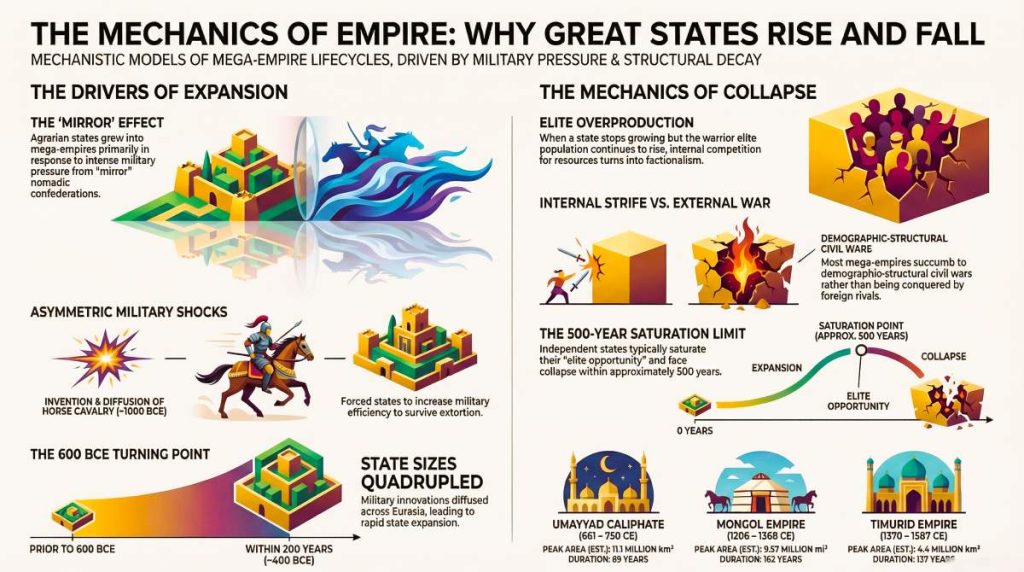
For practitioners of cliodynamics-the mathematical modeling of historical processes-these maps are profound illusions. Using agent-based computer simulations to “retrodict” the past, researchers have discovered something extraordinary: history isn’t random chaos. It’s a predictable “rhyming” process driven by external pressure and internal structural limits.
The findings force us to unlearn almost everything we thought we knew. The mighty Median Empire? Probably never existed. The great dynasties of Rome and Han China? Built not by visionaries, but by existential terror of nomadic raiders. The fall of empires? Not from barbarian hordes, but from internal rot when too many elites compete for too few spoils.
Here are five surprising truths about how mega-empires actually rise-and inevitably fall.
1. The Phantom Empire: The Median State That Probably Never Existed
For decades, the 1970s lists by political scientist Rein Taagepera (based on the 1968 Hammond Historical Atlas) recorded a massive Median Empire of 2.8 million square kilometers around 585 BCE. Standard textbooks taught this as fact.
Modern archaeology has demolished this claim. Scholar Heleen Sancisi-Weerdenburg’s investigations revealed a total absence of Median monumental buildings, royal storehouses, or administrative seals. The Medes were likely a decentralized tribal collection, not a unified superstate.
The correction has ripple effects: territory once attributed to the phantom Median Empire must now be reassigned. New evidence suggests the Neo-Babylonian Empire was far larger than previously thought, potentially crossing one million square kilometers by absorbing “Median” lands.
2. The Steppe Mirror: Nomads Built the Mega-Empires
Cliodynamic simulations reveal a counterintuitive truth: mega-empires like Han China and Rome weren’t built by great leaders-they were terrorized into existence by nomadic raiders.
Around 1000 BCE, horse cavalry provided an asymmetric military shock. Nomadic confederations could strike deep into agrarian heartlands with impunity. This threat occurred along the meta-ethnic frontier-the boundary between sedentary farmers and nomadic pastoralists where differences in language, religion, and lifestyle created existential fear.
To survive, agrarian states entered an “autocatalytic arms race,” scaling up their cooperation and military organization. The models show that the nomadic “arid zone” didn’t just raid states-it provided the pressure that forced small principalities to fuse into superstates. The nomadic raider was, paradoxically, the primary architect of the mega-empire.
3. The Internal Rot: Elite Overproduction Kills Empires
If external pressure builds empires, what destroys them? The answer: elite overproduction.
During expansion, the population of warrior elites-administrators, generals, political leaders-grows to manage new territory. But eventually, state growth hits a ceiling. While territory stops expanding, the elite population continues growing for another 6-8 generations. This creates a surplus of ambitious individuals competing for a shrinking pool of spoils.
This internal competition triggers Secular Cycles-predictable periods of instability where the state loses its ability to cooperate, leading to civil war and fragmentation. Empires rarely “fall” to outsiders; they fracture because they lose internal structural integrity.
4. The 500 BCE Phase Transition: When History Quadrupled
Data reveals a startling “phase transition” around 500 BCE. For millennia, states remained relatively small. Then suddenly, within 200 years, maximum empire size quadrupled.
This shift required a cluster of technologies enabling unprecedented power projection:
- Horse Cavalry: Rapid response and long-range military projection
- Agricultural Intensification: Tripled land carrying capacity, supporting massive bureaucracies and armies
- The 900 BCE Camel: “Ship of the desert” enabling transport across previously impassable arid barriers
- Littoral Sea Travel: Mediterranean maritime movement overcame land-locked limitations
Without these specific advantages, simulations show states would have remained localized and small.
5. Fuzzy Edges: The Cartographer’s Deception
Measuring empire area is an exercise in distinguishing diplomatic pretense from geopolitical reality. Ancient Great Kings might claim a million square kilometers because a distant chieftain once sent tribute horses-but actual administrative control might only exist within miles of a royal road.
As geographer Martin W. Lewis notes: “Diplomatic pretense habitually trumps geopolitical reality in our most basic depiction of the world.”
Map-making is often foreign policy establishment rather than a reflection of land actually governed. Modern states claim every grain of sand within borders, but a “grizzled war cartographer” knows control is fluid and fuzzy.
The Cliodynamic Framework: Understanding Empire Cycles
| Concept | Definition | Historical Impact |
|---|---|---|
| Cliodynamics | Mathematical modeling of historical processes using agent-based simulations | Reveals predictable patterns in empire rise and fall |
| Meta-ethnic Frontier | Boundary between sedentary farmers and nomadic pastoralists with stark cultural differences | Creates existential threat perception that drives state fusion |
| Asymmetric Military Shock | Revolutionary military technology (e.g., horse cavalry) that disrupts power balance | Forces “autocatalytic arms race” and state scaling |
| Elite Overproduction | Surplus of ambitious elites competing for fixed or shrinking spoils | Primary cause of internal collapse and civil war |
| Secular Cycles | Predictable periods of instability driven by demographic-structural pressure | Empires fracture from within after 6-8 generations of elite growth |
| Retrodict | Using mathematical models to test historical theories against archaeological data | Forces “unlearning” of incorrect historical narratives |
The 500 BCE Phase Transition: Technologies That Quadrupled Empire Size
| Technology | Timeline | Strategic Advantage | Impact on Empire Scale |
|---|---|---|---|
| Horse Cavalry | ~1000 BCE+ | Rapid military response; deep penetration raids | Created nomadic threat forcing agrarian state fusion |
| Camel Transportation | ~900 BCE+ | Long-distance transport across arid zones | Overcame Near East geographical barriers |
| Agricultural Intensification | ~600 BCE+ | Tripled land carrying capacity | Supported massive bureaucracies and standing armies |
| Littoral Sea Travel | ~500 BCE+ | Rapid Mediterranean maritime movement | Western states overcame land-locked limitations |
| Combined Effect | 700-500 BCE | Unprecedented power projection + resource management | Maximum empire size quadrupled in 200 years |
Empire Reality Check: Phantom vs. Verified States
| Empire | Traditional Size Claim | Modern Archaeological Assessment | Status |
|---|---|---|---|
| Median Empire | 2.8M km² (Taagepera 1970s) | No monumental buildings, seals, or storehouses found | Likely phantom state – decentralized tribes |
| Neo-Babylonian Empire | <1M km² (traditional) | Absorbed “Median” territory; crossed 1M km² threshold | Significantly larger than claimed |
| Achaemenid Persian | 5.5M km² at peak | Archaeological evidence supports vast administrative network | Verified mega-empire |
| Han Dynasty | 6M km² at peak | Extensive archaeological and textual evidence | Verified mega-empire |
| Roman Empire | 5M km² at peak | Well-documented administrative control | Verified mega-empire |
The Empire Lifecycle: A Predictable Pattern
| Phase | Duration | Characteristics | Driving Force |
|---|---|---|---|
| 1. Meta-ethnic Pressure | Centuries | External nomadic raids create existential threat | Asymmetric military shock (cavalry) |
| 2. Autocatalytic Fusion | 100-200 years | Small principalities forced to merge for survival | “Ultra-social” cooperation scaling |
| 3. Rapid Expansion | 50-150 years | Military conquest; territory and elite population both grow | High military efficiency parameter (s) |
| 4. Territorial Ceiling | Variable | Geography or logistics halt expansion; elites keep growing | Structural limits reached |
| 5. Elite Overproduction | 6-8 generations (~150-200 years) | Too many elites competing for fixed spoils | Demographic-structural pressure |
| 6. Secular Cycle (Collapse) | 50-100 years | Civil war, fragmentation, loss of cooperation | Internal competition destroys state capacity |
| 7. Fragmentation | Variable | Empire fractures into smaller states | Loss of “ultra-social” cohesion |
Measuring Empire: The Fuzzy Edge Problem
| Measurement Type | Example | Reliability | Problem |
|---|---|---|---|
| Diplomatic Claims | Great King receives tribute from distant chieftain | Low – Often exaggerated | Claims ≠ actual control |
| Administrative Control | Tax collection, garrisons, royal roads | Medium – Varies by region | Control often extends only miles from infrastructure |
| Archaeological Evidence | Monumental buildings, seals, storehouses | High – Physical proof | Absence proves lack of control |
| Modern Analogies | CIA World Factbook claims | Medium – Legal vs. practical | “Every grain of sand” claimed but not controlled |
| Cliodynamic Models | Simulated vs. actual territory | Variable – Model-dependent | Helps identify phantom states |
The Two Rhythms of History
| Rhythm | Direction | Driving Force | Duration | Outcome |
|---|---|---|---|---|
| Outward Expansion | External | Military necessity from meta-ethnic frontier pressure | 1-2 centuries | Mega-empire formation |
| Inward Fracture | Internal | Elite overproduction and demographic-structural pressure | 6-8 generations | Empire fragmentation |
The Bottom Line: History Rhymes, It Doesn’t Repeat
The mathematical analysis of empire reveals a profound truth: history is not one damn thing after another, but rather two-outward expansion driven by external military pressure, and inward collapse driven by elite competition.
Key takeaways:
- Mega-empires were forced into existence by nomadic threats, not built by visionary leaders
- Archaeological evidence trumps old maps – phantom empires like the Median state dissolve under scrutiny
- The 500 BCE phase transition required a specific cluster of technologies that quadrupled empire scale
- Elite overproduction is the primary killer – empires fracture from within after territory stops expanding but elite population keeps growing
- All historical maps have fuzzy edges – diplomatic claims rarely match administrative reality
We haven’t escaped these cycles. Looking at today’s “fuzzy edges”-contested borders, claimed-but-not-controlled territories, growing elite competition-we must ask: Which of our current borders are geopolitical realities, and which are merely the latest version of the cartographer’s illusion?
The ancient pattern persists. External pressure builds states. Internal competition fractures them. The rhythm continues, whether measured in bronze spearheads or nuclear arsenals. Understanding this pattern doesn’t free us from it-but it might help us recognize which phase of the cycle we’re currently living through.
FAQ
Q: Which empire was the largest in absolute terms?
A: The British Empire at 35.5 million km², followed by the Mongol Empire at 24 million km².
Q: Which empire controlled the largest percentage of world population?
A: The Achaemenid Persian Empire controlled about 44% of the global population around 480 BCE.
Q: What was the longest-lasting empire?
A: The Roman Empire, if including the Byzantine continuation, lasted from 27 BCE to 1453 CE (about 1,480 years). The Ottoman Empire lasted 623 years as a continuous political entity.
Q: Which empire expanded fastest?
A: The Mongol Empire and Rashidun Caliphate both achieved extraordinarily rapid expansion within decades.
Q: Were there empires in the Americas?
A: Yes, including the Inca Empire, Aztec Empire, and Maya civilization, though their land areas were smaller than Old World empires.
Q: Why did the Mongol Empire fragment?
A: After the death of Möngke Khan, the empire split into four khanates due to succession disputes and the impracticality of governing such vast territories from a single center.
Q: How did empires maintain control over distant territories?
A: Through provincial governors (satrapies, viceroyalties), military garrisons, efficient communication systems, local autonomy arrangements, and sometimes hostages or puppet rulers.
Conclusion: The Rise and Fall of Empires
The 30 largest empires in history demonstrate humanity’s capacity for both great achievement and terrible destruction. They built magnificent cities, advanced knowledge, facilitated trade, and created cultural treasures. They also brought war, slavery, exploitation, and suffering to millions.
These empires rose through military prowess, strategic location, innovative governance, economic strength, and historical circumstance. They fell through overextension, internal decay, external pressure, and failure to adapt. Yet their legacies endure in our languages, laws, cultures, and collective memory.
Today, in an age of nation-states and international organizations, the age of territorial empires has passed. However, understanding imperial history remains crucial for comprehending modern geopolitics, cultural diversity, and global interconnection. The greatest empires remind us that human ambition can reshape the world, for better and for worse, and that all power, no matter how great, is ultimately temporary.
As we face global challenges today – climate change, economic inequality, technological disruption, cultural conflict – the lessons of history’s largest empires offer both warnings and wisdom for navigating our interconnected world.
References and Further Reading
This article draws on extensive historical research and academic sources:
- Taagepera, Rein. “Size and Duration of Empires: Growth-Decline Curves, 600 B.C. to 600 A.D.” Social Science History, 1979.
- Britannica, The Editors of Encyclopaedia. “Largest Empires in History.”
- Various academic journals, historical texts, and peer-reviewed sources on specific empires.
- Previous knowledge, AI, etc.
For readers interested in deeper exploration, consult specialized histories of individual empires, archaeological findings, and primary source documents from these civilizations.