
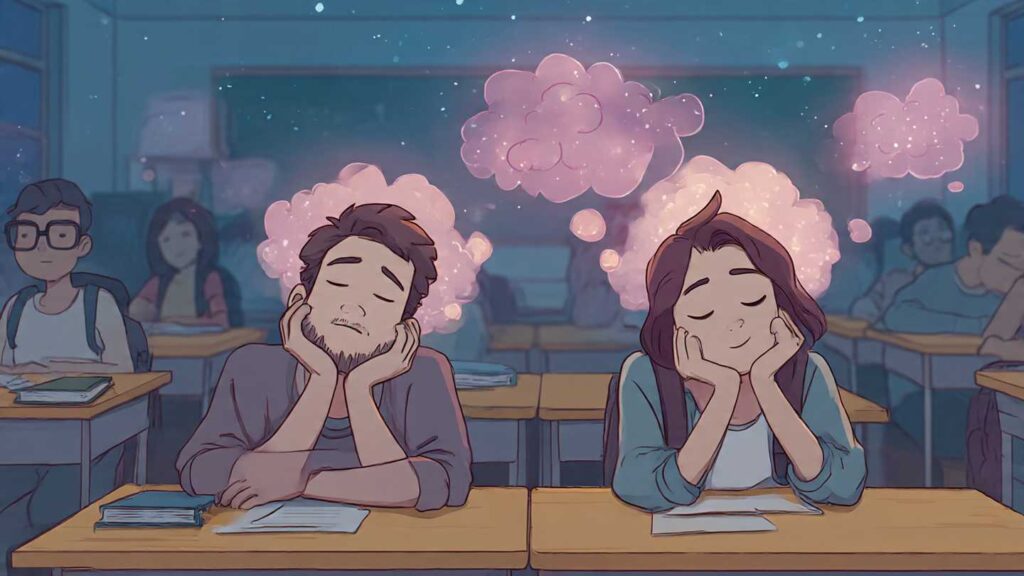
In this article we will discuss, What Is Bilateral Daydreaming in Students? (When the Brain Thinks in Two Directions at Once) so, Have you ever watched a student stare out the window, eyes unfocused, lips moving faintly, fingers tapping rhythmically, and thought they were lost in distraction?
- In reality, something far more complex might be happening.
- That student could be experiencing bilateral daydreaming, a subtle, rhythmic mental process where both hemispheres of the brain engage in alternating thought patterns, blending logic and emotion, memory and imagination, reason and intuition.
- Unlike ordinary daydreaming, which drifts randomly, bilateral daydreaming acts as a self-balancing system. It restores mental harmony, integrates emotion with learning, and helps students process experiences too complex for words.
It’s the mind’s silent therapy — half logic, half dream.
1. Understanding Bilateral Daydreaming
Bilateral daydreaming refers to the rhythmic activation of both brain hemispheres during periods of relaxed imagination or reflection.
- The left hemisphere governs analytical thought, sequence, and language.
- The right hemisphere governs imagery, intuition, emotion, and holistic awareness.
- When students daydream bilaterally, the two sides “take turns” leading thought, creating an internal conversation between logic and feeling.
- This is why a student might replay an event but then imagine “what if,” switching between factual memory and emotional narrative.
This gentle left-right alternation produces clarity, emotional release, and creative synthesis, similar to what happens during deep meditation or bilateral stimulation therapy (used in EMDR for trauma recovery).
2. The Neuroscience Behind It
Every time we move our eyes side-to-side, walk rhythmically, or breathe alternately, both brain hemispheres communicate through a structure called the corpus callosum. This communication balances memory storage, reasoning, and emotion regulation.
During bilateral daydreaming:
- The left brain organizes experiences into sequence and meaning.
- The right brain adds emotional color, imagery, and intuition.
- The two merge into integrated understanding — “I don’t just know it, I feel it.”
Brain scans show that this integration increases coherence between frontal (thinking) and limbic (feeling) areas, leading to better emotional intelligence and creative reasoning.
In short, the brain “talks to itself” and learns to agree.
Also read: What is Nocturnal Daydreaming in students?
3. How Bilateral Daydreaming Appears in Students
You can often identify it through small physical or behavioral cues:
- Eyes moving slightly left and right while thinking or imagining
- Gentle body sway during deep thought
- Pacing, walking, or finger-tapping while reflecting
- Alternating between rational and emotional interpretations of events (“I know it’s fine, but it still hurts”)
- Pauses of silence followed by bursts of insight
These moments look like idle daydreaming, but they are cognitive recalibrations — the brain’s natural way of aligning emotional and logical systems.
4. The Educational Relevance: Thinking That Feels
In education, we often separate emotion and reason — one for art, one for science.
Bilateral daydreaming defies this divide. It’s where understanding becomes whole.
When both hemispheres participate, learning transforms:
- Facts gain emotional meaning
- Creativity becomes structured
- Emotions become explainable
- Memory becomes more durable
For example, a history student imagining the emotion behind an event learns deeper than one who memorizes dates.
A science student visualizing molecules as dancing patterns understands better than one reciting formulas.
Bilateral daydreaming allows cognition to feel human — blending analysis with empathy.
5. Emotional Regulation Through Bilateral Thinking
The right brain stores emotional memory; the left brain helps label and explain it. When students are stressed or confused, one side often dominates — right (overwhelm) or left (overthinking).
- Bilateral daydreaming restores equilibrium by letting both sides speak.
- It’s similar to how the body balances itself through rhythm — walking, breathing, or even crying in waves.
That’s why after daydreaming, students often feel lighter or suddenly “understand” what was bothering them.
It’s not avoidance — it’s internal conversation completed.
6. The Connection to EMDR and Bilateral Stimulation
In trauma therapy, Eye Movement Desensitization and Reprocessing (EMDR) uses side-to-side stimulation — through eye movement, tapping, or sound — to process emotional pain and integrate it logically.
- Shower daydreaming, rhythmic walking, or gentle swaying can create similar bilateral effects naturally.
- For students, this unconscious rhythm helps process emotional tension caused by exams, failure, peer pressure, or personal stress.
So while it looks like zoning out, it’s actually self-directed regulation — the brain healing and integrating itself.
7. The Cognitive Advantage
Bilateral daydreaming enhances learning through three main mechanisms:
- Memory Integration — Combines sensory, emotional, and logical memories for deeper recall.
- Creative Synthesis — Links structured reasoning with imaginative association.
- Emotional Clarity — Helps label feelings accurately, preventing suppression or confusion.
Students who practice bilateral reflection (walking while thinking, journaling rhythmically, listening to binaural sounds) often show improved decision-making, empathy, and resilience.
8. How It Differs from Ordinary Daydreaming
| Ordinary Daydreaming | Bilateral Daydreaming |
|---|---|
| Random, scattered imagery | Structured flow between logic and emotion |
| Often escapist or fantasy-based | Integrative and restorative |
| May cause distraction or loss of focus | Leads to insight and calm clarity |
| Dominated by one hemisphere | Balanced activation of both hemispheres |
| Temporary relief | Long-term mental organization and balance |
9. Real-World Examples in Students
- A literature student paces slowly while rehearsing an essay — her movement synchronizes thought and rhythm, leading to emotional precision in writing.
- A science student solves a complex equation after mentally “walking through” its logic like a story.
- A nervous student recalls a painful classroom incident but reimagines it calmly, finding closure through balanced reflection.
Each case demonstrates bilateral engagement — using motion, rhythm, and imagination to merge intellect with emotion.
10. The Role of Movement and Rhythm
Bilateral daydreaming often coincides with movement because the body activates the brain symmetrically.
Walking, breathing alternately through each nostril, or even rhythmic tapping activates both hemispheres in sequence.
This is why:
- Walking clears thoughts.
- Dancing releases emotion.
- Writing in flow feels therapeutic.
For students, integrating movement with reflection — what psychologists call embodied cognition — multiplies focus, creativity, and calm.
11. Classroom Applications: Encouraging Balanced Thinking
Teachers can help students harness bilateral daydreaming without even naming it:
- Walking Discussions: Allow short reflective walks during group study.
- Rhythmic Learning: Use poetry, pacing, or gesture-based memory aids.
- Alternating Questioning: Ask logical and emotional questions about a topic (“What happened?” and “How might they have felt?”).
- Silent Reflection Periods: Give one-minute pauses after lessons for students to integrate knowledge subconsciously.
- Encourage Journaling with Rhythm: Writing continuously without pause engages bilateral flow through motion and sequencing.
When classrooms respect both logic and emotion, they nurture whole minds — not just trained ones.
12. Bilateral Daydreaming and Mental Health
Modern student life often overactivates one hemisphere — typically the left, through exams, analysis, and digital overload. Bilateral daydreaming naturally restores harmony by reconnecting the emotional self.
It:
- Reduces anxiety
- Improves sleep
- Prevents emotional shutdown
- Builds deeper self-awareness
Many students describe feeling “mentally lighter” after zoning out for a few minutes. That moment of silence is the nervous system rebalancing through bilateral rhythm.
13. How Students Can Practice Bilateral Reflection
Simple ways to stimulate balanced thinking:
- Rhythmic Walking or Cycling — Reflect while moving in rhythm.
- Mirror Journaling — Write alternating emotional and logical lines.
- Eye Movement Reflection — Gently move eyes left-right while recalling positive memories.
- Music with Balanced Beats — Binaural or instrumental rhythms aid creative focus.
- Alternate Nostril Breathing (Yoga Technique) — Synchronizes hemispheric activity.
These simple actions allow the subconscious and conscious mind to meet halfway — where understanding lives.
14. The Hidden Lesson: Learning Isn’t Linear
Bilateral daydreaming reminds us that learning is not mechanical — it’s rhythmic. The human brain was never meant to think only in one direction. It grows by oscillation: between logic and intuition, focus and freedom, thought and feeling.
- For students, respecting this inner rhythm is key. Productivity without reflection leads to burnout; reflection without direction leads to drift.
Bilateral daydreaming keeps both alive — the engine and the compass.
Table: Bilateral Daydreaming in Students (How It Works, Why It Matters, and How to Encourage It)
| How It Works (Neuroscience & Process) | Why It Matters (Psychological & Educational Benefits) | How to Encourage It (Practical Techniques) |
|---|---|---|
| Both hemispheres — left (logic) and right (emotion) — activate in rhythmic alternation through the corpus callosum | Builds whole-brain integration, balancing emotional intelligence with academic reasoning | Allow rhythmic reflection periods after study sessions to let both sides of the brain process together |
| Occurs naturally during slow eye movement, walking, tapping, or rhythmic breathing | Improves memory retention and creative problem-solving | Encourage walking discussions, stretching, or gentle movement during study |
| Activates the Default Mode Network (DMN) when attention relaxes | Helps the brain connect ideas subconsciously and produce insights | Include short breaks for rest and self-reflection after intense focus tasks |
| Mimics the effects of bilateral stimulation therapy (EMDR) used in emotional integration | Supports emotional healing, especially after stress, failure, or peer pressure | Teach alternate-nostril breathing or slow rhythmic journaling to calm both hemispheres |
| Alternates between rational and emotional thought streams | Encourages balanced decision-making and empathy | Combine logic-based and emotion-based questions in lessons (“How does it work?” + “How does it feel?”) |
| Creates natural rhythm between language and imagery processing | Enhances creativity and artistic imagination in academic contexts | Introduce music, art, or poetry-based learning alongside analytical subjects |
| Engages both hemispheres in storing memory (left: words; right: visuals) | Deepens understanding and long-term recall | Use color-coded notes or visual metaphors when teaching abstract topics |
| Occurs most during quiet solitude or repetitive activity | Reduces anxiety, mental fatigue, and overthinking | Encourage solo walks, journaling, or reflective writing after stressful study |
| Converts emotional experiences into logical insight | Increases self-awareness and emotional vocabulary | Let students journal alternatingly between “what happened” and “how I felt” |
| The body (movement) supports the brain’s rhythm | Creates mental clarity and restores focus | Promote mindful motion — walking, yoga, or doodling as part of reflection routines |
Summary Insight
- Bilateral daydreaming reveals that students don’t think in straight lines — they think in waves.
- Each side of the brain contributes something vital: logic offers clarity; emotion offers meaning.
- When teachers, parents, and students honor this internal rhythm, learning becomes not just efficient — but deeply human.
The mind becomes balanced, creative, and emotionally intelligent — the kind of intelligence education should truly aim for.
Conclusion: The Two Minds Within One Student
- Every student carries two learners inside them — one logical, one emotional.
- Bilateral daydreaming is the silent handshake between the two.
- It’s how the brain ensures that knowledge is not just memorized but understood, not just processed but felt.
When education acknowledges this rhythm — allowing time for reflection, emotion, and imagination — students no longer think in halves.
They think in harmony And that harmony, not speed or pressure, is what truly defines an intelligent mind.
FAQ: Bilateral Daydreaming Psychology in Students
1. What is bilateral daydreaming in students?
Bilateral daydreaming is a natural mental process where both sides of the brain — the left (logical) and right (emotional) hemispheres — activate in rhythm during relaxed thinking or imagination. It allows students to balance reason and feeling, often leading to clarity, creativity, and emotional relief.
2. How does bilateral daydreaming differ from normal daydreaming?
Ordinary daydreaming is often random or escapist, while bilateral daydreaming is integrative — it helps the brain process experiences consciously and emotionally at the same time. It’s more rhythmic and purposeful, producing calm insight instead of distraction or fantasy.
3. What happens in the brain during bilateral daydreaming?
Both hemispheres communicate through the corpus callosum, the bridge connecting them. The left side organizes logic, sequence, and words, while the right side processes imagery, emotion, and intuition. Their balanced rhythm leads to whole-brain thinking — connecting memory, feeling, and understanding in harmony.
4. Why is bilateral daydreaming important for students?
It helps students process emotions, reduce stress, and improve creative problem-solving. By alternating between logical and emotional thought, the brain integrates academic learning with personal meaning. This not only deepens understanding but also builds emotional intelligence and resilience.
5. Can bilateral daydreaming improve learning or memory?
Yes. When both hemispheres are active, memory storage becomes richer and more connected. Facts gain emotional significance, which improves recall. For example, students who visualize while reasoning or move rhythmically while studying engage both sides of the brain, leading to longer-lasting understanding.
6. How does movement or rhythm relate to bilateral thinking?
Physical movement — such as walking, tapping, or breathing rhythmically — naturally stimulates both brain hemispheres. That’s why students often think better while pacing, doodling, or listening to rhythmic music. Movement keeps the hemispheres in sync, making reflection deeper and less stressful.
7. Is bilateral daydreaming similar to EMDR therapy?
It’s related but not identical. EMDR (Eye Movement Desensitization and Reprocessing) is a structured therapy that uses left-right stimulation to process trauma. Bilateral daydreaming is the brain’s natural version of that process — an everyday form of gentle emotional integration and mental balancing.
8. How can teachers or parents support bilateral thinking in students?
They can encourage reflection and movement in learning:
- Allow short walking or stretching breaks.
- Combine logic-based tasks with creative exercises.
- Ask both analytical (“what happened?”) and emotional (“how did it feel?”) questions.
- Promote journaling, art, or rhythmic learning to engage both hemispheres.
Such practices make classrooms emotionally safer and cognitively richer.
9. What are the signs that a student is experiencing bilateral daydreaming?
Common signs include slow eye movement side-to-side, soft tapping or pacing, gentle body swaying, or a calm, thoughtful expression. Afterward, students often express new understanding, emotional release, or creative ideas. It’s the brain’s quiet reset — not a sign of inattention.
10. Can students practice bilateral daydreaming intentionally?
Yes. Simple techniques help:
- Walk while reflecting on a problem.
- Write or journal rhythmically without pausing.
- Use gentle side-to-side eye movements while thinking.
- Listen to balanced, binaural instrumental music.
- Practice alternate-nostril breathing for 2–3 minutes.
These small habits align the hemispheres, reduce mental noise, and help students think with both clarity and calmness.